COMMON WEAKNESS ENUMERATIONStable

CWE-119

Improper Restriction of Operations within the Bounds of a Memory Buffer

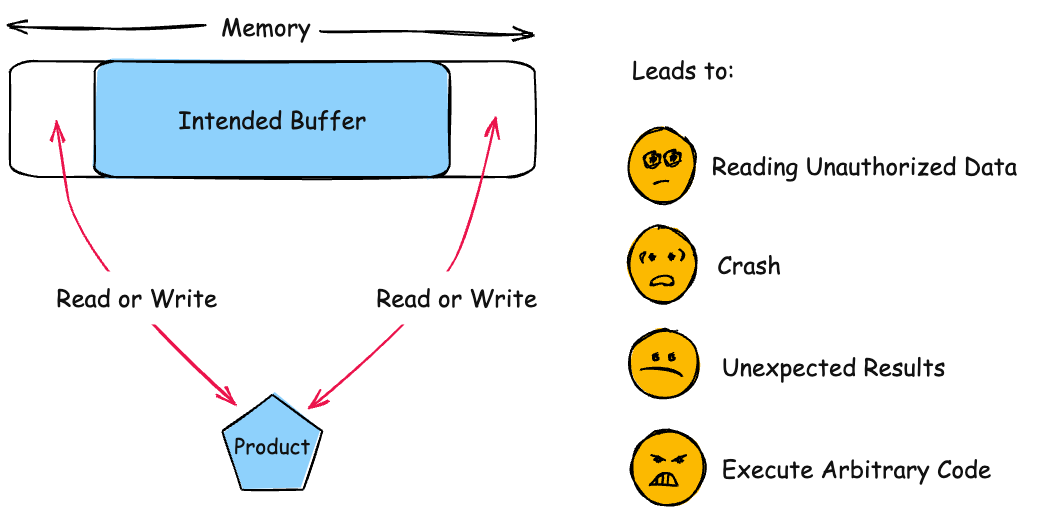
The product performs operations on a memory buffer, but it reads from or writes to a memory location outside the buffer's intended boundary. This may result in read or write operations on unexpected memory locations that could be linked to other variables, data structures, or internal program data.

Soyutlama

Class

Yapı

Simple

Sömürü İhtimali

High

Problemi anla

Problem nedir?

The product performs operations on a memory buffer, but it reads from or writes to a memory location outside the buffer's intended boundary. This may result in read or write operations on unexpected memory locations that could be linked to other variables, data structures, or internal program data.

Terminoloji

Alternatif adlar ve kullanım biçimleri

Buffer Overflow

This term has many different meanings to different audiences. From a CWE mapping perspective, this term should be avoided where possible. Some researchers, developers, and tools intend for it to mean "write past the end of a buffer," whereas others use the same term to mean "any read or write outside the boundaries of a buffer, whether before the beginning of the buffer or after the end of the buffer." Others could mean "any action after the end of a buffer, whether it is a read or write." Since the term is commonly used for exploitation and for vulnerabilities, it further confuses things.

buffer overrun

Some prominent vendors and researchers use the term "buffer overrun," but most people use "buffer overflow." See the alternate term for "buffer overflow" for context.

memory safety

Generally used for techniques that avoid weaknesses related to memory access, such as those identified by CWE-119 and its descendants. However, the term is not formal, and there is likely disagreement between practitioners as to which weaknesses are implicitly covered by the "memory safety" term.

Kök neden

Problem nasıl ve ne zaman oluşur?

Yaşam döngüsü evresi

Implementation

Certain languages allow direct addressing of memory locations and do not automatically ensure that these locations are valid for the memory buffer that is being referenced.

Risk

Başarılı sömürü neye yol açar?

Execute Unauthorized Code or CommandsModify Memory

Etkilenen güvenlik alanları: Integrity, Confidentiality, Availability

If the memory accessible by the attacker can be effectively controlled, it may be possible to execute arbitrary code, as with a standard buffer overflow. If the attacker can overwrite a pointer's worth of memory (usually 32 or 64 bits), they can alter the intended control flow by redirecting a function pointer to their own malicious code. Even when the attacker can only modify a single byte arbitrary code execution can be possible. Sometimes this is because the same problem can be exploited repeatedly to the same effect. Other times it is because the attacker can overwrite security-critical application-specific data -- such as a flag indicating whether the user is an administrator.
Read MemoryDoS: Crash, Exit, or RestartDoS: Resource Consumption (CPU)DoS: Resource Consumption (Memory)

Etkilenen güvenlik alanları: Availability, Confidentiality

Out of bounds memory access will very likely result in the corruption of relevant memory, and perhaps instructions, possibly leading to a crash. Other attacks leading to lack of availability are possible, including putting the program into an infinite loop.
Read Memory

Etkilenen güvenlik alanları: Confidentiality

In the case of an out-of-bounds read, the attacker may have access to sensitive information. If the sensitive information contains system details, such as the current buffer's position in memory, this knowledge can be used to craft further attacks, possibly with more severe consequences.

Savunma

Nasıl önlenir ve çözülür?

Requirements

Language Selection

Detay
Use a language that does not allow this weakness to occur or provides constructs that make this weakness easier to avoid. For example, many languages that perform their own memory management, such as Java and Perl, are not subject to buffer overflows. Other languages, such as Ada and C#, typically provide overflow protection, but the protection can be disabled by the programmer. Be wary that a language's interface to native code may still be subject to overflows, even if the language itself is theoretically safe.

Architecture and Design

Libraries or Frameworks

Detay
Use a vetted library or framework that does not allow this weakness to occur or provides constructs that make this weakness easier to avoid. Examples include the Safe C String Library (SafeStr) by Messier and Viega [REF-57], and the Strsafe.h library from Microsoft [REF-56]. These libraries provide safer versions of overflow-prone string-handling functions.

This is not a complete solution, since many buffer overflows are not related to strings.

Operation · Build and Compilation

Environment Hardening

Detay
Use automatic buffer overflow detection mechanisms that are offered by certain compilers or compiler extensions. Examples include: the Microsoft Visual Studio /GS flag, Fedora/Red Hat FORTIFY_SOURCE GCC flag, StackGuard, and ProPolice, which provide various mechanisms including canary-based detection and range/index checking. D3-SFCV (Stack Frame Canary Validation) from D3FEND [REF-1334] discusses canary-based detection in detail.

Etkinlik: Defense in Depth

This is not necessarily a complete solution, since these mechanisms only detect certain types of overflows. In addition, the result is still a denial of service, since the typical response is to exit the application.

Implementation

Uygulama aşaması savunması

Detay
Consider adhering to the following rules when allocating and managing an application's memory: - Double check that the buffer is as large as specified. - When using functions that accept a number of bytes to copy, such as strncpy(), be aware that if the destination buffer size is equal to the source buffer size, it may not NULL-terminate the string. - Check buffer boundaries if accessing the buffer in a loop and make sure there is no danger of writing past the allocated space. - If necessary, truncate all input strings to a reasonable length before passing them to the copy and concatenation functions.

Operation · Build and Compilation

Environment Hardening

Detay
Run or compile the software using features or extensions that randomly arrange the positions of a program's executable and libraries in memory. Because this makes the addresses unpredictable, it can prevent an attacker from reliably jumping to exploitable code. Examples include Address Space Layout Randomization (ASLR) [REF-58] [REF-60] and Position-Independent Executables (PIE) [REF-64]. Imported modules may be similarly realigned if their default memory addresses conflict with other modules, in a process known as "rebasing" (for Windows) and "prelinking" (for Linux) [REF-1332] using randomly generated addresses. ASLR for libraries cannot be used in conjunction with prelink since it would require relocating the libraries at run-time, defeating the whole purpose of prelinking. For more information on these techniques see D3-SAOR (Segment Address Offset Randomization) from D3FEND [REF-1335].

Etkinlik: Defense in Depth

These techniques do not provide a complete solution. For instance, exploits frequently use a bug that discloses memory addresses in order to maximize reliability of code execution [REF-1337]. It has also been shown that a side-channel attack can bypass ASLR [REF-1333].

Operation

Environment Hardening

Detay
Use a CPU and operating system that offers Data Execution Protection (using hardware NX or XD bits) or the equivalent techniques that simulate this feature in software, such as PaX [REF-60] [REF-61]. These techniques ensure that any instruction executed is exclusively at a memory address that is part of the code segment. For more information on these techniques see D3-PSEP (Process Segment Execution Prevention) from D3FEND [REF-1336].

Etkinlik: Defense in Depth

This is not a complete solution, since buffer overflows could be used to overwrite nearby variables to modify the software's state in dangerous ways. In addition, it cannot be used in cases in which self-modifying code is required. Finally, an attack could still cause a denial of service, since the typical response is to exit the application.

Implementation

Uygulama aşaması savunması

Detay
Replace unbounded copy functions with analogous functions that support length arguments, such as strcpy with strncpy. Create these if they are not available.

Etkinlik: Moderate

This approach is still susceptible to calculation errors, including issues such as off-by-one errors (CWE-193) and incorrectly calculating buffer lengths (CWE-131).

Doğrulama

Nasıl tespit edilir?

Automated Static Analysis

High
This weakness can often be detected using automated static analysis tools. Many modern tools use data flow analysis or constraint-based techniques to minimize the number of false positives. Automated static analysis generally does not account for environmental considerations when reporting out-of-bounds memory operations. This can make it difficult for users to determine which warnings should be investigated first. For example, an analysis tool might report buffer overflows that originate from command line arguments in a program that is not expected to run with setuid or other special privileges.

Detection techniques for buffer-related errors are more mature than for most other weakness types.

Automated Dynamic Analysis

This weakness can be detected using dynamic tools and techniques that interact with the software using large test suites with many diverse inputs, such as fuzz testing (fuzzing), robustness testing, and fault injection. The software's operation may slow down, but it should not become unstable, crash, or generate incorrect results.

Automated Dynamic Analysis

Moderate
Use tools that are integrated during compilation to insert runtime error-checking mechanisms related to memory safety errors, such as AddressSanitizer (ASan) for C/C++ [REF-1518].

Crafted inputs are necessary to reach the code containing the error, such as generated by fuzzers. Also, these tools may reduce performance, and they only report the error condition - not the original mistake that led to the error.

Automated Static Analysis - Binary or Bytecode

SOAR Partial
According to SOAR [REF-1479], the following detection techniques may be useful: ``` Cost effective for partial coverage: ``` Binary / Bytecode Quality Analysis Bytecode Weakness Analysis - including disassembler + source code weakness analysis Binary Weakness Analysis - including disassembler + source code weakness analysis

Manual Static Analysis - Binary or Bytecode

SOAR Partial
According to SOAR [REF-1479], the following detection techniques may be useful: ``` Cost effective for partial coverage: ``` Binary / Bytecode disassembler - then use manual analysis for vulnerabilities & anomalies

Dynamic Analysis with Automated Results Interpretation

SOAR Partial
According to SOAR [REF-1479], the following detection techniques may be useful: ``` Cost effective for partial coverage: ``` Web Application Scanner Web Services Scanner Database Scanners

Dynamic Analysis with Manual Results Interpretation

SOAR Partial
According to SOAR [REF-1479], the following detection techniques may be useful: ``` Cost effective for partial coverage: ``` Fuzz Tester Framework-based Fuzzer

Manual Static Analysis - Source Code

SOAR Partial
According to SOAR [REF-1479], the following detection techniques may be useful: ``` Cost effective for partial coverage: ``` Focused Manual Spotcheck - Focused manual analysis of source Manual Source Code Review (not inspections)

Automated Static Analysis - Source Code

High
According to SOAR [REF-1479], the following detection techniques may be useful: ``` Highly cost effective: ``` Source code Weakness Analyzer Context-configured Source Code Weakness Analyzer ``` Cost effective for partial coverage: ``` Source Code Quality Analyzer

Architecture or Design Review

High
According to SOAR [REF-1479], the following detection techniques may be useful: ``` Highly cost effective: ``` Formal Methods / Correct-By-Construction ``` Cost effective for partial coverage: ``` Inspection (IEEE 1028 standard) (can apply to requirements, design, source code, etc.)

MITRE görseli

Zafiyet ilişkisi ve akışı
CWE-119 MITRE diagramı