COMMON WEAKNESS ENUMERATIONDraft
CWE-311
Missing Encryption of Sensitive Data
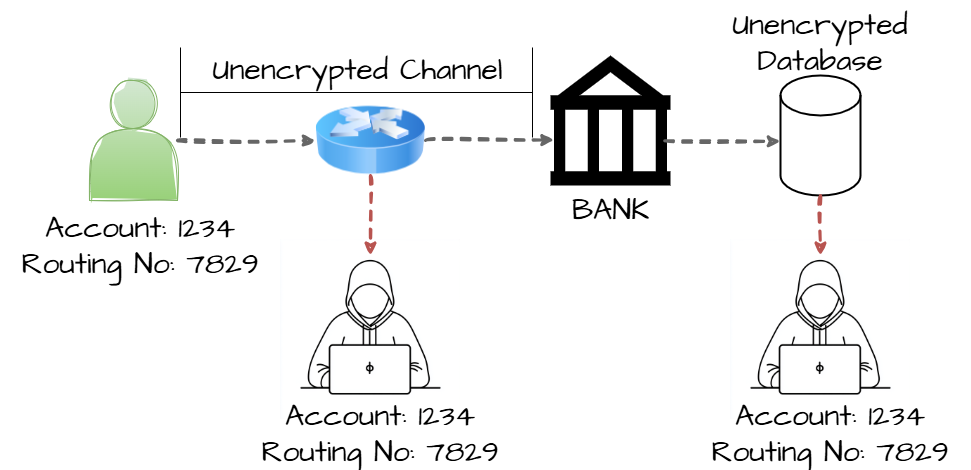
The product does not encrypt sensitive or critical information before storage or transmission.
Soyutlama
Class
Yapı
Simple
Sömürü İhtimali
High
Problemi anla
Problem nedir?
The product does not encrypt sensitive or critical information before storage or transmission.
Kök neden
Problem nasıl ve ne zaman oluşur?
Yaşam döngüsü evresi
Architecture and Design
OMISSION: This weakness is caused by missing a security tactic during the architecture and design phase.
Yaşam döngüsü evresi
Operation
Risk
Başarılı sömürü neye yol açar?
Read Application Data
Etkilenen güvenlik alanları: Confidentiality
If the application does not use a secure channel, such as SSL, to exchange sensitive information, it is possible for an attacker with access to the network traffic to sniff packets from the connection and uncover the data. This attack is not technically difficult, but does require physical access to some portion of the network over which the sensitive data travels. This access is usually somewhere near where the user is connected to the network (such as a colleague on the company network) but can be anywhere along the path from the user to the end server.
Modify Application Data
Etkilenen güvenlik alanları: Confidentiality, Integrity
Omitting the use of encryption in any program which transfers data over a network of any kind should be considered on par with delivering the data sent to each user on the local networks of both the sender and receiver. Worse, this omission allows for the injection of data into a stream of communication between two parties -- with no means for the victims to separate valid data from invalid. In this day of widespread network attacks and password collection sniffers, it is an unnecessary risk to omit encryption from the design of any system which might benefit from it.
Savunma
Nasıl önlenir ve çözülür?
Requirements
Güvenlik gereksinimi
Detay
Requirements
Güvenlik gereksinimi
Clearly specify which data or resources are valuable enough that they should be protected by encryption. Require that any transmission or storage of this data/resource should use well-vetted encryption algorithms.
Architecture and Design
Mimari ve tasarım yaklaşımı
Detay
Architecture and Design
Mimari ve tasarım yaklaşımı
Ensure that encryption is properly integrated into the system design, including but not necessarily limited to:
- Encryption that is needed to store or transmit private data of the users of the system
- Encryption that is needed to protect the system itself from unauthorized disclosure or tampering
Identify the separate needs and contexts for encryption:
- One-way (i.e., only the user or recipient needs to have the key). This can be achieved using public key cryptography, or other techniques in which the encrypting party (i.e., the product) does not need to have access to a private key.
- Two-way (i.e., the encryption can be automatically performed on behalf of a user, but the key must be available so that the plaintext can be automatically recoverable by that user). This requires storage of the private key in a format that is recoverable only by the user (or perhaps by the operating system) in a way that cannot be recovered by others.
Using threat modeling or other techniques, assume that data can be compromised through a separate vulnerability or weakness, and determine where encryption will be most effective. Ensure that data that should be private is not being inadvertently exposed using weaknesses such as insecure permissions (CWE-732). [REF-7]
Architecture and Design
Libraries or Frameworks
Detay
Architecture and Design
Libraries or Frameworks
When there is a need to store or transmit sensitive data, use strong, up-to-date cryptographic algorithms to encrypt that data. Select a well-vetted algorithm that is currently considered to be strong by experts in the field, and use well-tested implementations. As with all cryptographic mechanisms, the source code should be available for analysis.
For example, US government systems require FIPS 140-2 certification.
Do not develop custom or private cryptographic algorithms. They will likely be exposed to attacks that are well-understood by cryptographers. Reverse engineering techniques are mature. If the algorithm can be compromised if attackers find out how it works, then it is especially weak.
Periodically ensure that the cryptography has not become obsolete. Some older algorithms, once thought to require a billion years of computing time, can now be broken in days or hours. This includes MD4, MD5, SHA1, DES, and other algorithms that were once regarded as strong. [REF-267]
Architecture and Design
Separation of Privilege
Detay
Architecture and Design
Separation of Privilege
Compartmentalize the system to have "safe" areas where trust boundaries can be unambiguously drawn. Do not allow sensitive data to go outside of the trust boundary and always be careful when interfacing with a compartment outside of the safe area.
Ensure that appropriate compartmentalization is built into the system design, and the compartmentalization allows for and reinforces privilege separation functionality. Architects and designers should rely on the principle of least privilege to decide the appropriate time to use privileges and the time to drop privileges.
Implementation · Architecture and Design
Birden fazla yaşam döngüsü evresinde uygulanacak savunma
Detay
Implementation · Architecture and Design
Birden fazla yaşam döngüsü evresinde uygulanacak savunma
When using industry-approved techniques, use them correctly. Don't cut corners by skipping resource-intensive steps (CWE-325). These steps are often essential for preventing common attacks.
Implementation
Attack Surface Reduction
Detay
Implementation
Attack Surface Reduction
Use naming conventions and strong types to make it easier to spot when sensitive data is being used. When creating structures, objects, or other complex entities, separate the sensitive and non-sensitive data as much as possible.
Etkinlik: Defense in Depth
This makes it easier to spot places in the code where data is being used that is unencrypted.
Doğrulama
Nasıl tespit edilir?
Manual Analysis
HighThe characterizaton of sensitive data often requires domain-specific understanding, so manual methods are useful. However, manual efforts might not achieve desired code coverage within limited time constraints. Black box methods may produce artifacts (e.g. stored data or unencrypted network transfer) that require manual evaluation.
Automated Analysis
Automated measurement of the entropy of an input/output source may indicate the use or lack of encryption, but human analysis is still required to distinguish intentionally-unencrypted data (e.g. metadata) from sensitive data.
Manual Static Analysis - Binary or Bytecode
SOAR PartialAccording to SOAR [REF-1479], the following detection techniques may be useful:
```
Cost effective for partial coverage:
```
Binary / Bytecode disassembler - then use manual analysis for vulnerabilities & anomalies
Dynamic Analysis with Automated Results Interpretation
SOAR PartialAccording to SOAR [REF-1479], the following detection techniques may be useful:
```
Cost effective for partial coverage:
```
Web Application Scanner
Web Services Scanner
Database Scanners
Dynamic Analysis with Manual Results Interpretation
HighAccording to SOAR [REF-1479], the following detection techniques may be useful:
```
Highly cost effective:
```
Network Sniffer
```
Cost effective for partial coverage:
```
Fuzz Tester
Framework-based Fuzzer
Automated Monitored Execution
Man-in-the-middle attack tool
Manual Static Analysis - Source Code
HighAccording to SOAR [REF-1479], the following detection techniques may be useful:
```
Highly cost effective:
```
Focused Manual Spotcheck - Focused manual analysis of source
Manual Source Code Review (not inspections)
Automated Static Analysis - Source Code
SOAR PartialAccording to SOAR [REF-1479], the following detection techniques may be useful:
```
Cost effective for partial coverage:
```
Context-configured Source Code Weakness Analyzer
Architecture or Design Review
HighAccording to SOAR [REF-1479], the following detection techniques may be useful:
```
Highly cost effective:
```
Inspection (IEEE 1028 standard) (can apply to requirements, design, source code, etc.)
Formal Methods / Correct-By-Construction
```
Cost effective for partial coverage:
```
Attack Modeling
MITRE görseli
Zafiyet ilişkisi ve akışı