COMMON WEAKNESS ENUMERATIONDraft

CWE-401

Missing Release of Memory after Effective Lifetime

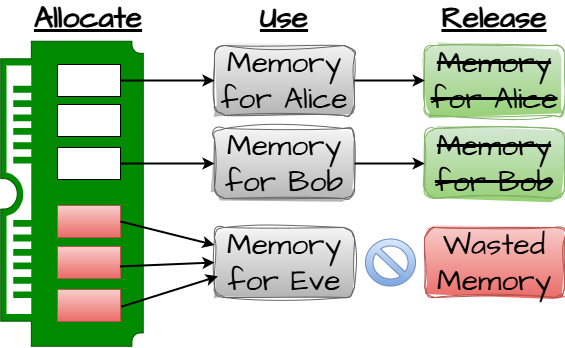
The product does not sufficiently track and release allocated memory after it has been used, making the memory unavailable for reallocation and reuse.

Soyutlama

Variant

Yapı

Simple

Sömürü İhtimali

Medium

Problemi anla

Problem nedir?

The product does not sufficiently track and release allocated memory after it has been used, making the memory unavailable for reallocation and reuse.

Terminoloji

Alternatif adlar ve kullanım biçimleri

Memory Leak

a common term for not releasing memory; however, the same term is also used for "disclosure of sensitive information from memory," so use of this term is discouraged.

Kök neden

Problem nasıl ve ne zaman oluşur?

Yaşam döngüsü evresi

Implementation

Memory leaks have two common and sometimes overlapping causes: - Error conditions and other exceptional circumstances often triggered by improper handling of malformed data or unexpectedly interrupted sessions. - Confusion over which part of the program is responsible for freeing the memory, since in some languages, developers are responsible for tracking memory allocation and releasing the memory. If there are no more pointers or references to the memory, then it can no longer be tracked and identified for release.

Risk

Başarılı sömürü neye yol açar?

DoS: Crash, Exit, or RestartDoS: InstabilityDoS: Resource Consumption (CPU)DoS: Resource Consumption (Memory)

Etkilenen güvenlik alanları: Availability

Most memory leaks result in general product reliability problems, but if an attacker can intentionally trigger a memory leak, the attacker might be able to launch a denial of service attack (by crashing or hanging the program) or take advantage of other unexpected program behavior resulting from a low memory condition.
Reduce Performance

Etkilenen güvenlik alanları: Other

Savunma

Nasıl önlenir ve çözülür?

Implementation

Libraries or Frameworks

Detay
Choose a language or tool that provides automatic memory management, or makes manual memory management less error-prone. For example, glibc in Linux provides protection against free of invalid pointers. When using Xcode to target OS X or iOS, enable automatic reference counting (ARC) [REF-391]. To help correctly and consistently manage memory when programming in C++, consider using a smart pointer class such as std::auto_ptr (defined by ISO/IEC ISO/IEC 14882:2003), std::shared_ptr and std::unique_ptr (specified by an upcoming revision of the C++ standard, informally referred to as C++ 1x), or equivalent solutions such as Boost.

Architecture and Design

Mimari ve tasarım yaklaşımı

Detay
Use an abstraction library to abstract away risky APIs. Not a complete solution.

Architecture and Design · Build and Compilation

Birden fazla yaşam döngüsü evresinde uygulanacak savunma

Detay
Consider using the Boehm-Demers-Weiser garbage collector (bdwgc), which can help avoid leaks.

Etkinlik: Moderate

This is not a complete solution as it is not 100% effective.

Doğrulama

Nasıl tespit edilir?

Fuzzing

High
Fuzz testing (fuzzing) is a powerful technique for generating large numbers of diverse inputs - either randomly or algorithmically - and dynamically invoking the code with those inputs. Even with random inputs, it is often capable of generating unexpected results such as crashes, memory corruption, or resource consumption. Fuzzing effectively produces repeatable test cases that clearly indicate bugs, which helps developers to diagnose the issues.

Automated Dynamic Analysis

Moderate
Use tools that are integrated during compilation to insert runtime error-checking mechanisms related to memory safety errors, such as AddressSanitizer (ASan) for C/C++ [REF-1518] or valgrind [REF-480].

Crafted inputs are necessary to reach the code containing the error, such as generated by fuzzers. Also, these tools may reduce performance, and they only report the error condition - not the original mistake that led to the error.

Automated Static Analysis

High
Automated static analysis, commonly referred to as Static Application Security Testing (SAST), can find some instances of this weakness by analyzing source code (or binary/compiled code) without having to execute it. Typically, this is done by building a model of data flow and control flow, then searching for potentially-vulnerable patterns that connect "sources" (origins of input) with "sinks" (destinations where the data interacts with external components, a lower layer such as the OS, etc.)

MITRE görseli

Zafiyet ilişkisi ve akışı
CWE-401 MITRE diagramı