COMMON WEAKNESS ENUMERATIONDraft

CWE-77

Improper Neutralization of Special Elements used in a Command ('Command Injection')

The product constructs all or part of a command using externally-influenced input from an upstream component, but it does not neutralize or incorrectly neutralizes special elements that could modify the intended command when it is sent to a downstream component.

Soyutlama

Class

Yapı

Simple

Sömürü İhtimali

High

Problemi anla

Problem nedir?

The product constructs all or part of a command using externally-influenced input from an upstream component, but it does not neutralize or incorrectly neutralizes special elements that could modify the intended command when it is sent to a downstream component.

Genişletilmiş açıklama

Many protocols and products have their own custom command language. While OS or shell command strings are frequently discovered and targeted, developers may not realize that these other command languages might also be vulnerable to attacks.

Terminoloji

Alternatif adlar ve kullanım biçimleri

Command injection

an attack-oriented phrase for this weakness. Note: often used when "OS command injection" (CWE-78) was intended.

Kök neden

Problem nasıl ve ne zaman oluşur?

Yaşam döngüsü evresi

Implementation

Command injection vulnerabilities typically occur when: 1. Data enters the application from an untrusted source. 1. The data is part of a string that is executed as a command by the application.

Yaşam döngüsü evresi

Implementation

REALIZATION: This weakness is caused during implementation of an architectural security tactic.

Risk

Başarılı sömürü neye yol açar?

Execute Unauthorized Code or Commands

Etkilenen güvenlik alanları: Integrity, Confidentiality, Availability

If a malicious user injects a character (such as a semi-colon) that delimits the end of one command and the beginning of another, it may be possible to then insert an entirely new and unrelated command that was not intended to be executed. This gives an attacker a privilege or capability that they would not otherwise have.

Savunma

Nasıl önlenir ve çözülür?

Architecture and Design

Mimari ve tasarım yaklaşımı

Detay
If at all possible, use library calls rather than external processes to recreate the desired functionality.

Implementation

Uygulama aşaması savunması

Detay
If possible, ensure that all external commands called from the program are statically created.

Implementation

Input Validation

Detay
Assume all input is malicious. Use an "accept known good" input validation strategy, i.e., use a list of acceptable inputs that strictly conform to specifications. Reject any input that does not strictly conform to specifications, or transform it into something that does. When performing input validation, consider all potentially relevant properties, including length, type of input, the full range of acceptable values, missing or extra inputs, syntax, consistency across related fields, and conformance to business rules. As an example of business rule logic, "boat" may be syntactically valid because it only contains alphanumeric characters, but it is not valid if the input is only expected to contain colors such as "red" or "blue." Do not rely exclusively on looking for malicious or malformed inputs. This is likely to miss at least one undesirable input, especially if the code's environment changes. This can give attackers enough room to bypass the intended validation. However, denylists can be useful for detecting potential attacks or determining which inputs are so malformed that they should be rejected outright.

Operation

Operasyonel savunma

Detay
Run time: Run time policy enforcement may be used in an allowlist fashion to prevent use of any non-sanctioned commands.

System Configuration

Güvenli yapılandırma yaklaşımı

Detay
Assign permissions that prevent the user from accessing/opening privileged files.

Doğrulama

Nasıl tespit edilir?

Automated Static Analysis

High
Automated static analysis, commonly referred to as Static Application Security Testing (SAST), can find some instances of this weakness by analyzing source code (or binary/compiled code) without having to execute it. Typically, this is done by building a model of data flow and control flow, then searching for potentially-vulnerable patterns that connect "sources" (origins of input) with "sinks" (destinations where the data interacts with external components, a lower layer such as the OS, etc.)

MITRE görseli

Zafiyet ilişkisi ve akışı
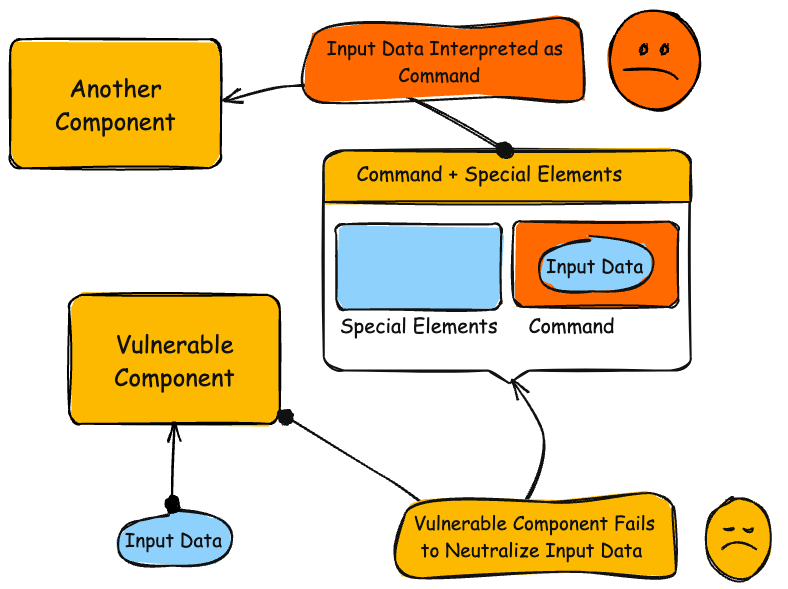
CWE-77 MITRE diagramı
CWE-77: Common Weakness Enumeration Entry CWE-77 · DayBreach Sözlük · DayBreach