COMMON WEAKNESS ENUMERATIONIncomplete

CWE-862

Missing Authorization

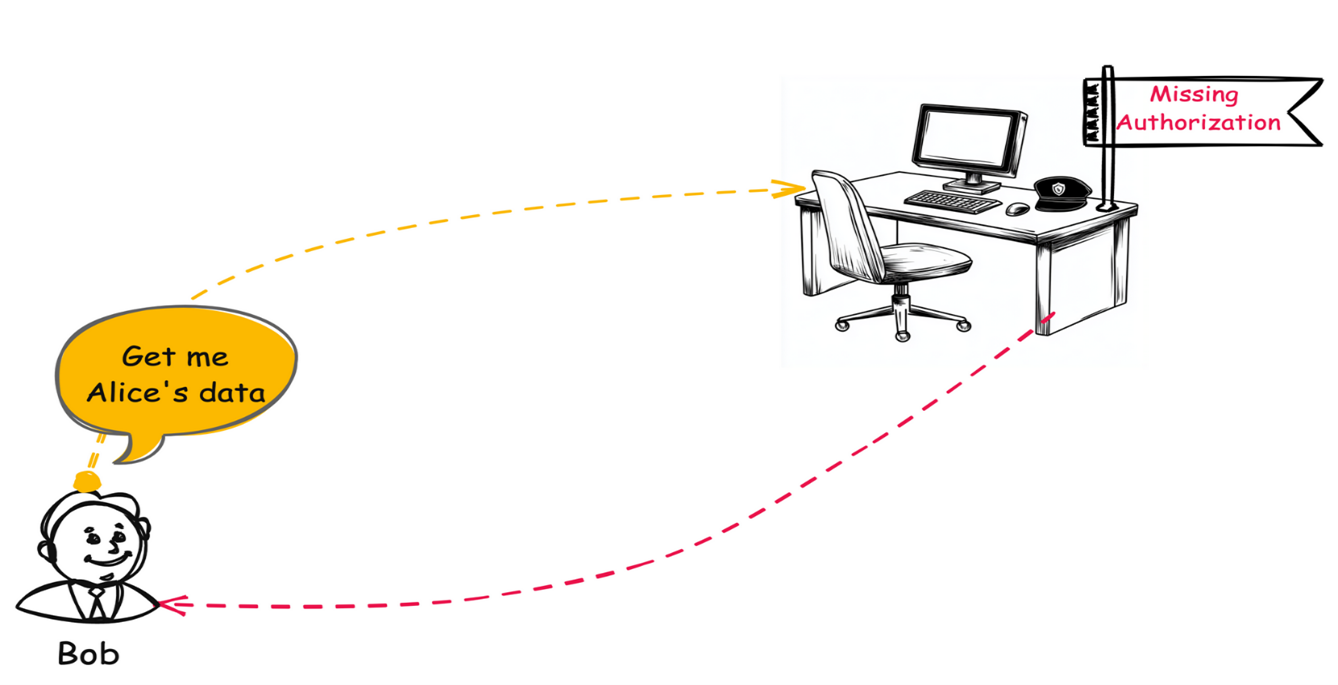
The product does not perform an authorization check when an actor attempts to access a resource or perform an action.

Soyutlama

Class

Yapı

Simple

Sömürü İhtimali

High

Problemi anla

Problem nedir?

The product does not perform an authorization check when an actor attempts to access a resource or perform an action.

Terminoloji

Alternatif adlar ve kullanım biçimleri

AuthZ

"AuthZ" is typically used as an abbreviation of "authorization" within the web application security community. It is distinct from "AuthN" (or, sometimes, "AuthC") which is an abbreviation of "authentication." The use of "Auth" as an abbreviation is discouraged, since it could be used for either authentication or authorization.

Kök neden

Problem nasıl ve ne zaman oluşur?

Yaşam döngüsü evresi

Architecture and Design

OMISSION: This weakness is caused by missing a security tactic during the architecture and design phase. Authorization weaknesses may arise when a single-user application is ported to a multi-user environment.

Yaşam döngüsü evresi

Implementation

A developer may introduce authorization weaknesses because of a lack of understanding about the underlying technologies. For example, a developer may assume that attackers cannot modify certain inputs such as headers or cookies.

Yaşam döngüsü evresi

Operation

An access control list (ACL) represents who/what has permissions to a given object. Different operating systems implement (ACLs) in different ways. In UNIX, there are three types of permissions: read, write, and execute. Users are divided into three classes for file access: owner, group owner, and all other users where each class has a separate set of rights. In Windows NT, there are four basic types of permissions for files: "No access", "Read access", "Change access", and "Full control". Windows NT extends the concept of three types of users in UNIX to include a list of users and groups along with their associated permissions. A user can create an object (file) and assign specified permissions to that object.

Risk

Başarılı sömürü neye yol açar?

Read Application DataRead Files or Directories

Etkilenen güvenlik alanları: Confidentiality

An attacker could read sensitive data, either by reading the data directly from a data store that is not restricted, or by accessing insufficiently-protected, privileged functionality to read the data.
Modify Application DataModify Files or Directories

Etkilenen güvenlik alanları: Integrity

An attacker could modify sensitive data, either by writing the data directly to a data store that is not restricted, or by accessing insufficiently-protected, privileged functionality to write the data.
Gain Privileges or Assume IdentityBypass Protection Mechanism

Etkilenen güvenlik alanları: Access Control

An attacker could gain privileges by modifying or reading critical data directly, or by accessing privileged functionality.
DoS: Crash, Exit, or RestartDoS: Resource Consumption (CPU)DoS: Resource Consumption (Memory)DoS: Resource Consumption (Other)

Etkilenen güvenlik alanları: Availability

An attacker could gain unauthorized access to resources on the system and excessively consume those resources, leading to a denial of service.

Savunma

Nasıl önlenir ve çözülür?

Architecture and Design

Mimari ve tasarım yaklaşımı

Detay
Divide the product into anonymous, normal, privileged, and administrative areas. Reduce the attack surface by carefully mapping roles with data and functionality. Use role-based access control (RBAC) [REF-229] to enforce the roles at the appropriate boundaries. Note that this approach may not protect against horizontal authorization, i.e., it will not protect a user from attacking others with the same role.

Architecture and Design

Mimari ve tasarım yaklaşımı

Detay
Ensure that access control checks are performed related to the business logic. These checks may be different than the access control checks that are applied to more generic resources such as files, connections, processes, memory, and database records. For example, a database may restrict access for medical records to a specific database user, but each record might only be intended to be accessible to the patient and the patient's doctor [REF-7].

Architecture and Design

Libraries or Frameworks

Detay
Use a vetted library or framework that does not allow this weakness to occur or provides constructs that make this weakness easier to avoid. For example, consider using authorization frameworks such as the JAAS Authorization Framework [REF-233] and the OWASP ESAPI Access Control feature [REF-45].

Architecture and Design

Mimari ve tasarım yaklaşımı

Detay
For web applications, make sure that the access control mechanism is enforced correctly at the server side on every page. Users should not be able to access any unauthorized functionality or information by simply requesting direct access to that page. One way to do this is to ensure that all pages containing sensitive information are not cached, and that all such pages restrict access to requests that are accompanied by an active and authenticated session token associated with a user who has the required permissions to access that page.

System Configuration · Installation

Birden fazla yaşam döngüsü evresinde uygulanacak savunma

Detay
Use the access control capabilities of your operating system and server environment and define your access control lists accordingly. Use a "default deny" policy when defining these ACLs.

Doğrulama

Nasıl tespit edilir?

Automated Static Analysis

Limited
Automated static analysis is useful for detecting commonly-used idioms for authorization. A tool may be able to analyze related configuration files, such as .htaccess in Apache web servers, or detect the usage of commonly-used authorization libraries. Generally, automated static analysis tools have difficulty detecting custom authorization schemes. In addition, the software's design may include some functionality that is accessible to any user and does not require an authorization check; an automated technique that detects the absence of authorization may report false positives.

Automated Dynamic Analysis

Automated dynamic analysis may find many or all possible interfaces that do not require authorization, but manual analysis is required to determine if the lack of authorization violates business logic.

Manual Analysis

Moderate
This weakness can be detected using tools and techniques that require manual (human) analysis, such as penetration testing, threat modeling, and interactive tools that allow the tester to record and modify an active session. Specifically, manual static analysis is useful for evaluating the correctness of custom authorization mechanisms.

These may be more effective than strictly automated techniques. This is especially the case with weaknesses that are related to design and business rules. However, manual efforts might not achieve desired code coverage within limited time constraints.

Manual Static Analysis - Binary or Bytecode

SOAR Partial
According to SOAR [REF-1479], the following detection techniques may be useful: ``` Cost effective for partial coverage: ``` Binary / Bytecode disassembler - then use manual analysis for vulnerabilities & anomalies

Dynamic Analysis with Automated Results Interpretation

SOAR Partial
According to SOAR [REF-1479], the following detection techniques may be useful: ``` Cost effective for partial coverage: ``` Web Application Scanner Web Services Scanner Database Scanners

Dynamic Analysis with Manual Results Interpretation

SOAR Partial
According to SOAR [REF-1479], the following detection techniques may be useful: ``` Cost effective for partial coverage: ``` Host Application Interface Scanner Fuzz Tester Framework-based Fuzzer

Manual Static Analysis - Source Code

SOAR Partial
According to SOAR [REF-1479], the following detection techniques may be useful: ``` Cost effective for partial coverage: ``` Focused Manual Spotcheck - Focused manual analysis of source Manual Source Code Review (not inspections)

Automated Static Analysis - Source Code

SOAR Partial
According to SOAR [REF-1479], the following detection techniques may be useful: ``` Cost effective for partial coverage: ``` Source code Weakness Analyzer Context-configured Source Code Weakness Analyzer

Architecture or Design Review

High
According to SOAR [REF-1479], the following detection techniques may be useful: ``` Highly cost effective: ``` Inspection (IEEE 1028 standard) (can apply to requirements, design, source code, etc.) Formal Methods / Correct-By-Construction

MITRE görseli

Zafiyet ilişkisi ve akışı
CWE-862 MITRE diagramı