COMMON WEAKNESS ENUMERATIONIncomplete

CWE-95

Improper Neutralization of Directives in Dynamically Evaluated Code ('Eval Injection')

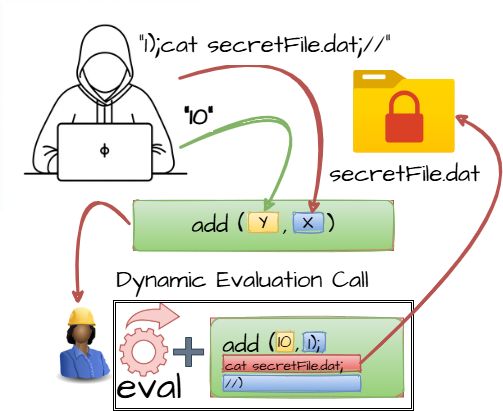
The product receives input from an upstream component, but it does not neutralize or incorrectly neutralizes code syntax before using the input in a dynamic evaluation call (e.g. "eval").

Soyutlama

Variant

Yapı

Simple

Sömürü İhtimali

Medium

Problemi anla

Problem nedir?

The product receives input from an upstream component, but it does not neutralize or incorrectly neutralizes code syntax before using the input in a dynamic evaluation call (e.g. "eval").

Kök neden

Problem nasıl ve ne zaman oluşur?

Yaşam döngüsü evresi

Implementation

REALIZATION: This weakness is caused during implementation of an architectural security tactic.

Yaşam döngüsü evresi

Implementation

This weakness is prevalent in handler/dispatch procedures that might want to invoke a large number of functions, or set a large number of variables.

Risk

Başarılı sömürü neye yol açar?

Read Files or DirectoriesRead Application Data

Etkilenen güvenlik alanları: Confidentiality

The injected code could access restricted data / files.
Bypass Protection Mechanism

Etkilenen güvenlik alanları: Access Control

In some cases, injectable code controls authentication; this may lead to a remote vulnerability.
Gain Privileges or Assume Identity

Etkilenen güvenlik alanları: Access Control

Injected code can access resources that the attacker is directly prevented from accessing.
Execute Unauthorized Code or Commands

Etkilenen güvenlik alanları: Integrity, Confidentiality, Availability, Other

Code injection attacks can lead to loss of data integrity in nearly all cases as the control-plane data injected is always incidental to data recall or writing. Additionally, code injection can often result in the execution of arbitrary code or at least modify what code can be executed.
Hide Activities

Etkilenen güvenlik alanları: Non-Repudiation

Often the actions performed by injected control code are unlogged.

Savunma

Nasıl önlenir ve çözülür?

Architecture and Design · Implementation

Refactoring

Detay
If possible, refactor your code so that it does not need to use eval() at all.

Implementation

Input Validation

Detay
Assume all input is malicious. Use an "accept known good" input validation strategy, i.e., use a list of acceptable inputs that strictly conform to specifications. Reject any input that does not strictly conform to specifications, or transform it into something that does. When performing input validation, consider all potentially relevant properties, including length, type of input, the full range of acceptable values, missing or extra inputs, syntax, consistency across related fields, and conformance to business rules. As an example of business rule logic, "boat" may be syntactically valid because it only contains alphanumeric characters, but it is not valid if the input is only expected to contain colors such as "red" or "blue." Do not rely exclusively on looking for malicious or malformed inputs. This is likely to miss at least one undesirable input, especially if the code's environment changes. This can give attackers enough room to bypass the intended validation. However, denylists can be useful for detecting potential attacks or determining which inputs are so malformed that they should be rejected outright.

Implementation

Uygulama aşaması savunması

Detay
Inputs should be decoded and canonicalized to the application's current internal representation before being validated (CWE-180, CWE-181). Make sure that your application does not inadvertently decode the same input twice (CWE-174). Such errors could be used to bypass allowlist schemes by introducing dangerous inputs after they have been checked. Use libraries such as the OWASP ESAPI Canonicalization control. Consider performing repeated canonicalization until your input does not change any more. This will avoid double-decoding and similar scenarios, but it might inadvertently modify inputs that are allowed to contain properly-encoded dangerous content.

Implementation

Uygulama aşaması savunması

Detay
For Python programs, it is frequently encouraged to use the ast.literal_eval() function instead of eval, since it is intentionally designed to avoid executing code. However, an adversary could still cause excessive memory or stack consumption via deeply nested structures [REF-1372], so the python documentation discourages use of ast.literal_eval() on untrusted data [REF-1373].

Etkinlik: Discouraged Common Practice

Doğrulama

Nasıl tespit edilir?

Automated Static Analysis

High
Automated static analysis, commonly referred to as Static Application Security Testing (SAST), can find some instances of this weakness by analyzing source code (or binary/compiled code) without having to execute it. Typically, this is done by building a model of data flow and control flow, then searching for potentially-vulnerable patterns that connect "sources" (origins of input) with "sinks" (destinations where the data interacts with external components, a lower layer such as the OS, etc.)

MITRE görseli

Zafiyet ilişkisi ve akışı
CWE-95 MITRE diagramı