COMMON WEAKNESS ENUMERATIONIncomplete

CWE-1004

Sensitive Cookie Without 'HttpOnly' Flag

The product uses a cookie to store sensitive information, but the cookie is not marked with the HttpOnly flag.

Abstraction

Variant

Structure

Simple

Likelihood of Exploit

Medium

Understand the problem

What is the problem?

The product uses a cookie to store sensitive information, but the cookie is not marked with the HttpOnly flag.

Root cause

How and when does the problem arise?

Lifecycle phase

Implementation

The HttpOnly flag directs compatible browsers to prevent client-side script from accessing cookies. Including the HttpOnly flag in the Set-Cookie HTTP response header helps mitigate the risk associated with Cross-Site Scripting (XSS) where an attacker's script code might attempt to read the contents of a cookie and exfiltrate information obtained. When set, browsers that support the flag will not reveal the contents of the cookie to a third party via client-side script executed via XSS.
An HTTP cookie is a small piece of data attributed to a specific website and stored on the user's computer by the user's web browser. This data can be leveraged for a variety of purposes including saving information entered into form fields, recording user activity, and for authentication purposes. Cookies used to save or record information generated by the user are accessed and modified by script code embedded in a web page. While cookies used for authentication are created by the website's server and sent to the user to be attached to future requests. These authentication cookies are often not meant to be accessed by the web page sent to the user, and are instead just supposed to be attached to future requests to verify authentication details.

Risk

What does successful exploitation lead to?

Read Application Data

Affected security scopes: Confidentiality

If the HttpOnly flag is not set, then sensitive information stored in the cookie may be exposed to unintended parties.
Gain Privileges or Assume Identity

Affected security scopes: Integrity

If the cookie in question is an authentication cookie, then not setting the HttpOnly flag may allow an adversary to steal authentication data (e.g., a session ID) and assume the identity of the user.

Defence

How is it prevented and fixed?

Implementation

Implementation-phase defence

Detail
Leverage the HttpOnly flag when setting a sensitive cookie in a response.

Effectiveness: High

While this mitigation is effective for protecting cookies from a browser's own scripting engine, third-party components or plugins may have their own engines that allow access to cookies. Attackers might also be able to use XmlHttpResponse to read the headers directly and obtain the cookie.

Verification

How is it detected?

Automated Static Analysis

High
Automated static analysis, commonly referred to as Static Application Security Testing (SAST), can find some instances of this weakness by analyzing source code (or binary/compiled code) without having to execute it. Typically, this is done by building a model of data flow and control flow, then searching for potentially-vulnerable patterns that connect "sources" (origins of input) with "sinks" (destinations where the data interacts with external components, a lower layer such as the OS, etc.)

MITRE diagram

Weakness relationships and flow
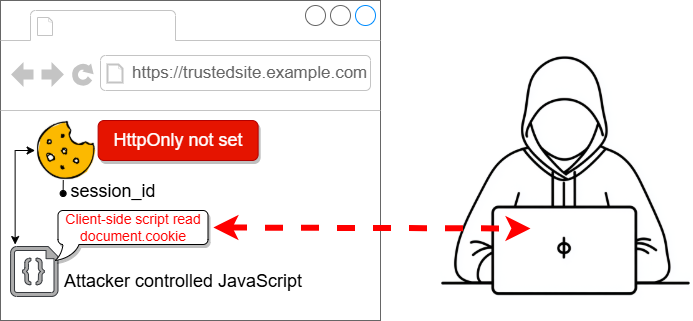
CWE-1004 MITRE diagramı