COMMON WEAKNESS ENUMERATIONIncomplete

CWE-1104

Use of Unmaintained Third Party Components

The product relies on third-party components that are not actively supported or maintained by the original developer or a trusted proxy for the original developer.

Abstraction

Base

Structure

Simple

Likelihood of Exploit

Medium

Understand the problem

What is the problem?

The product relies on third-party components that are not actively supported or maintained by the original developer or a trusted proxy for the original developer.

Root cause

How and when does the problem arise?

Lifecycle phase

Architecture and Design

Risk

What does successful exploitation lead to?

Reduce MaintainabilityVaries by Context

Affected security scopes: Other

Relying on unmaintained components makes it difficult or impossible to fix significant bugs and vulnerabilities, can render code obsolete, and undermine security by complicating maintenance and increasing the risk of new vulnerabilities.

Defence

How is it prevented and fixed?

  • Follow secure coding guidelines for input handling and boundary checking.
  • Enforce strict security reviews and automated static analysis (SAST) checks.

Verification

How is it detected?

Automated Static Analysis

High
Automated static analysis, commonly referred to as Static Application Security Testing (SAST), can find some instances of this weakness by analyzing source code (or binary/compiled code) without having to execute it. Typically, this is done by building a model of data flow and control flow, then searching for potentially-vulnerable patterns that connect "sources" (origins of input) with "sinks" (destinations where the data interacts with external components, a lower layer such as the OS, etc.)

MITRE diagram

Weakness relationships and flow
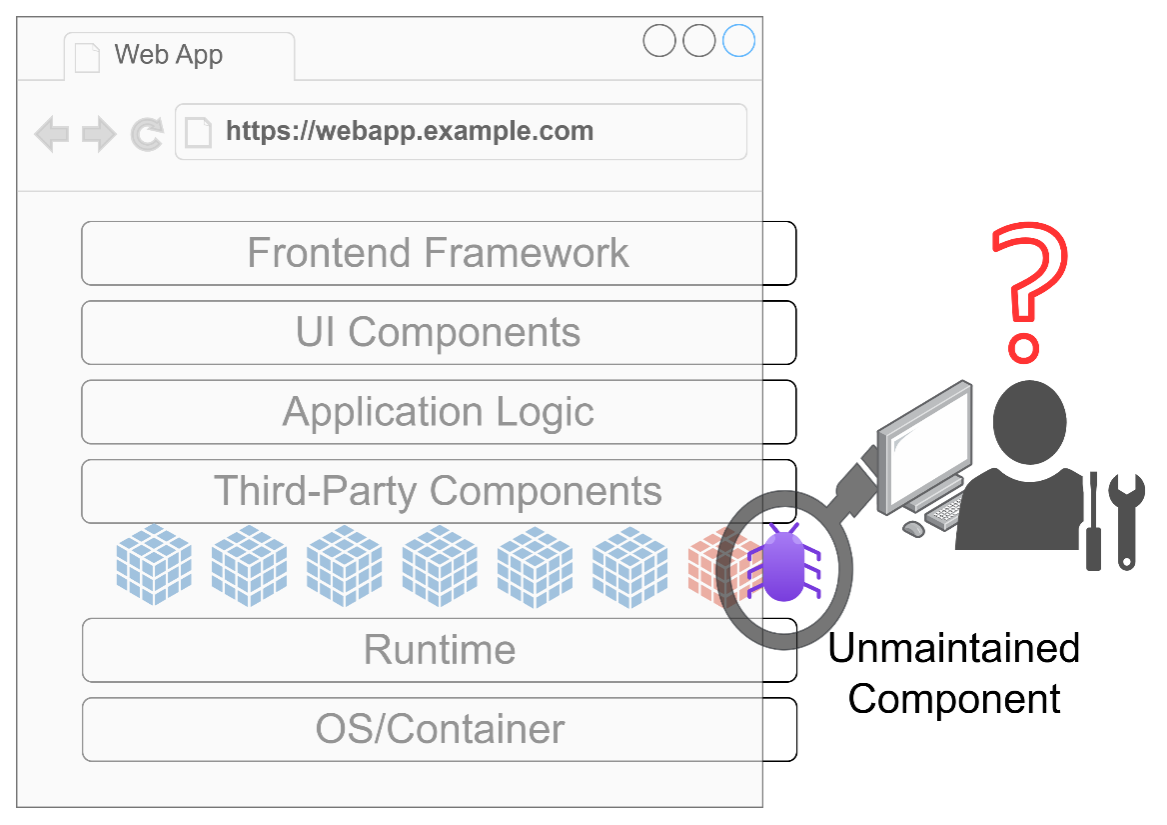
CWE-1104 MITRE diagramı