COMMON WEAKNESS ENUMERATIONStable

CWE-190

Integer Overflow or Wraparound

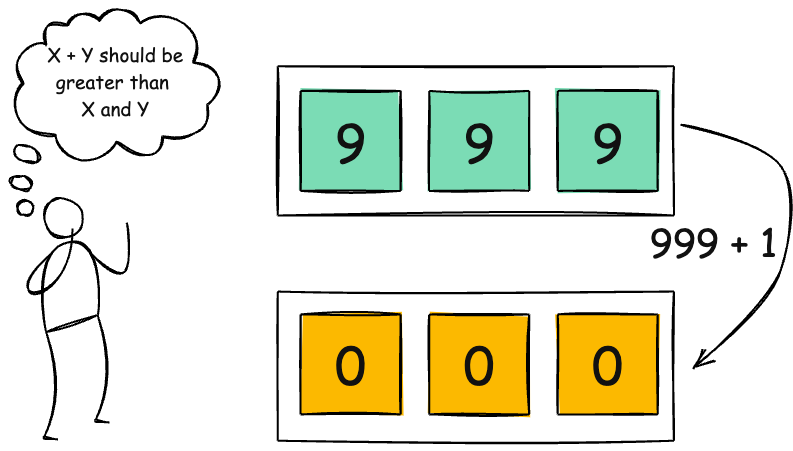
The product performs a calculation that can produce an integer overflow or wraparound when the logic assumes that the resulting value will always be larger than the original value. This occurs when an integer value is incremented to a value that is too large to store in the associated representation. When this occurs, the value may become a very small or negative number.

Abstraction

Base

Structure

Simple

Likelihood of Exploit

Medium

Understand the problem

What is the problem?

The product performs a calculation that can produce an integer overflow or wraparound when the logic assumes that the resulting value will always be larger than the original value. This occurs when an integer value is incremented to a value that is too large to store in the associated representation. When this occurs, the value may become a very small or negative number.

Terminology

Alternate terms and usages

Overflow

The terms "overflow" and "wraparound" are used interchangeably by some people, but they can have more precise distinctions by others. See Terminology Notes.

Wraparound

The terms "overflow" and "wraparound" are used interchangeably by some people, but they can have more precise distinctions by others. See Terminology Notes.

wrap, wrap-around, wrap around

Alternate spellings of "wraparound"

Root cause

How and when does the problem arise?

Lifecycle phase

Implementation

This weakness may become security critical when determining the offset or size in behaviors such as memory allocation, copying, and concatenation.

Risk

What does successful exploitation lead to?

DoS: Crash, Exit, or RestartDoS: Resource Consumption (Memory)DoS: Instability

Affected security scopes: Availability

This weakness can generally lead to undefined behavior and therefore crashes. When the calculated result is used for resource allocation, this weakness can cause too many (or too few) resources to be allocated, possibly enabling crashes if the product requests more resources than can be provided.
Modify Memory

Affected security scopes: Integrity

If the value in question is important to data (as opposed to flow), simple data corruption has occurred. Also, if the overflow/wraparound results in other conditions such as buffer overflows, further memory corruption may occur.
Execute Unauthorized Code or CommandsBypass Protection Mechanism

Affected security scopes: Confidentiality, Availability, Access Control

This weakness can sometimes trigger buffer overflows, which can be used to execute arbitrary code. This is usually outside the scope of the product's implicit security policy.
Alter Execution LogicDoS: Crash, Exit, or RestartDoS: Resource Consumption (CPU)

Affected security scopes: Availability, Other

If the overflow/wraparound occurs in a loop index variable, this could cause the loop to terminate at the wrong time - too early, too late, or not at all (i.e., infinite loops). With too many iterations, some loops could consume too many resources such as memory, file handles, etc., possibly leading to a crash or other DoS.
Bypass Protection Mechanism

Affected security scopes: Access Control

If integer values are used in security-critical decisions, such as calculating quotas or allocation limits, integer overflows can be used to cause an incorrect security decision.

Defence

How is it prevented and fixed?

Requirements

Security requirement

Detail
Ensure that all protocols are strictly defined, such that all out-of-bounds behavior can be identified simply, and require strict conformance to the protocol.

Requirements

Language Selection

Detail
Use a language that does not allow this weakness to occur or provides constructs that make this weakness easier to avoid. If possible, choose a language or compiler that performs automatic bounds checking.

Architecture and Design

Libraries or Frameworks

Detail
Use a vetted library or framework that does not allow this weakness to occur or provides constructs that make this weakness easier to avoid [REF-1482]. Use libraries or frameworks that make it easier to handle numbers without unexpected consequences. Examples include safe integer handling packages such as SafeInt (C++) or IntegerLib (C or C++). [REF-106]

Implementation

Input Validation

Detail
Perform input validation on any numeric input by ensuring that it is within the expected range. Enforce that the input meets both the minimum and maximum requirements for the expected range. Use unsigned integers where possible. This makes it easier to perform validation for integer overflows. When signed integers are required, ensure that the range check includes minimum values as well as maximum values.

Implementation

Implementation-phase defence

Detail
Understand the programming language's underlying representation and how it interacts with numeric calculation (CWE-681). Pay close attention to byte size discrepancies, precision, signed/unsigned distinctions, truncation, conversion and casting between types, "not-a-number" calculations, and how the language handles numbers that are too large or too small for its underlying representation. [REF-7] Also be careful to account for 32-bit, 64-bit, and other potential differences that may affect the numeric representation.

Architecture and Design

Architecture and design approach

Detail
For any security checks that are performed on the client side, ensure that these checks are duplicated on the server side, in order to avoid CWE-602. Attackers can bypass the client-side checks by modifying values after the checks have been performed, or by changing the client to remove the client-side checks entirely. Then, these modified values would be submitted to the server.

Implementation

Compilation or Build Hardening

Detail
Examine compiler warnings closely and eliminate problems with potential security implications, such as signed / unsigned mismatch in memory operations, or use of uninitialized variables. Even if the weakness is rarely exploitable, a single failure may lead to the compromise of the entire system.

Verification

How is it detected?

Automated Static Analysis

High
This weakness can often be detected using automated static analysis tools. Many modern tools use data flow analysis or constraint-based techniques to minimize the number of false positives.

Black Box

Moderate
Sometimes, evidence of this weakness can be detected using dynamic tools and techniques that interact with the product using large test suites with many diverse inputs, such as fuzz testing (fuzzing), robustness testing, and fault injection. The product's operation may slow down, but it should not become unstable, crash, or generate incorrect results.

Without visibility into the code, black box methods may not be able to sufficiently distinguish this weakness from others, requiring follow-up manual methods to diagnose the underlying problem.

Manual Analysis

High
This weakness can be detected using tools and techniques that require manual (human) analysis, such as penetration testing, threat modeling, and interactive tools that allow the tester to record and modify an active session. Specifically, manual static analysis is useful for evaluating the correctness of allocation calculations. This can be useful for detecting overflow conditions (CWE-190) or similar weaknesses that might have serious security impacts on the program.

These may be more effective than strictly automated techniques. This is especially the case with weaknesses that are related to design and business rules.

Automated Static Analysis - Binary or Bytecode

High
According to SOAR [REF-1479], the following detection techniques may be useful: ``` Highly cost effective: ``` Bytecode Weakness Analysis - including disassembler + source code weakness analysis Binary Weakness Analysis - including disassembler + source code weakness analysis

Dynamic Analysis with Manual Results Interpretation

SOAR Partial
According to SOAR [REF-1479], the following detection techniques may be useful: ``` Cost effective for partial coverage: ``` Fuzz Tester Framework-based Fuzzer

Manual Static Analysis - Source Code

SOAR Partial
According to SOAR [REF-1479], the following detection techniques may be useful: ``` Cost effective for partial coverage: ``` Manual Source Code Review (not inspections)

Automated Static Analysis - Source Code

High
According to SOAR [REF-1479], the following detection techniques may be useful: ``` Highly cost effective: ``` Source code Weakness Analyzer Context-configured Source Code Weakness Analyzer

Architecture or Design Review

High
According to SOAR [REF-1479], the following detection techniques may be useful: ``` Highly cost effective: ``` Formal Methods / Correct-By-Construction ``` Cost effective for partial coverage: ``` Inspection (IEEE 1028 standard) (can apply to requirements, design, source code, etc.)

MITRE diagram

Weakness relationships and flow
CWE-190 MITRE diagramı