COMMON WEAKNESS ENUMERATIONIncomplete

CWE-204

Observable Response Discrepancy

The product provides different responses to incoming requests in a way that reveals internal state information to an unauthorized actor outside of the intended control sphere.

Abstraction

Base

Structure

Simple

Likelihood of Exploit

Medium

Understand the problem

What is the problem?

The product provides different responses to incoming requests in a way that reveals internal state information to an unauthorized actor outside of the intended control sphere.

Root cause

How and when does the problem arise?

Lifecycle phase

Architecture and Design

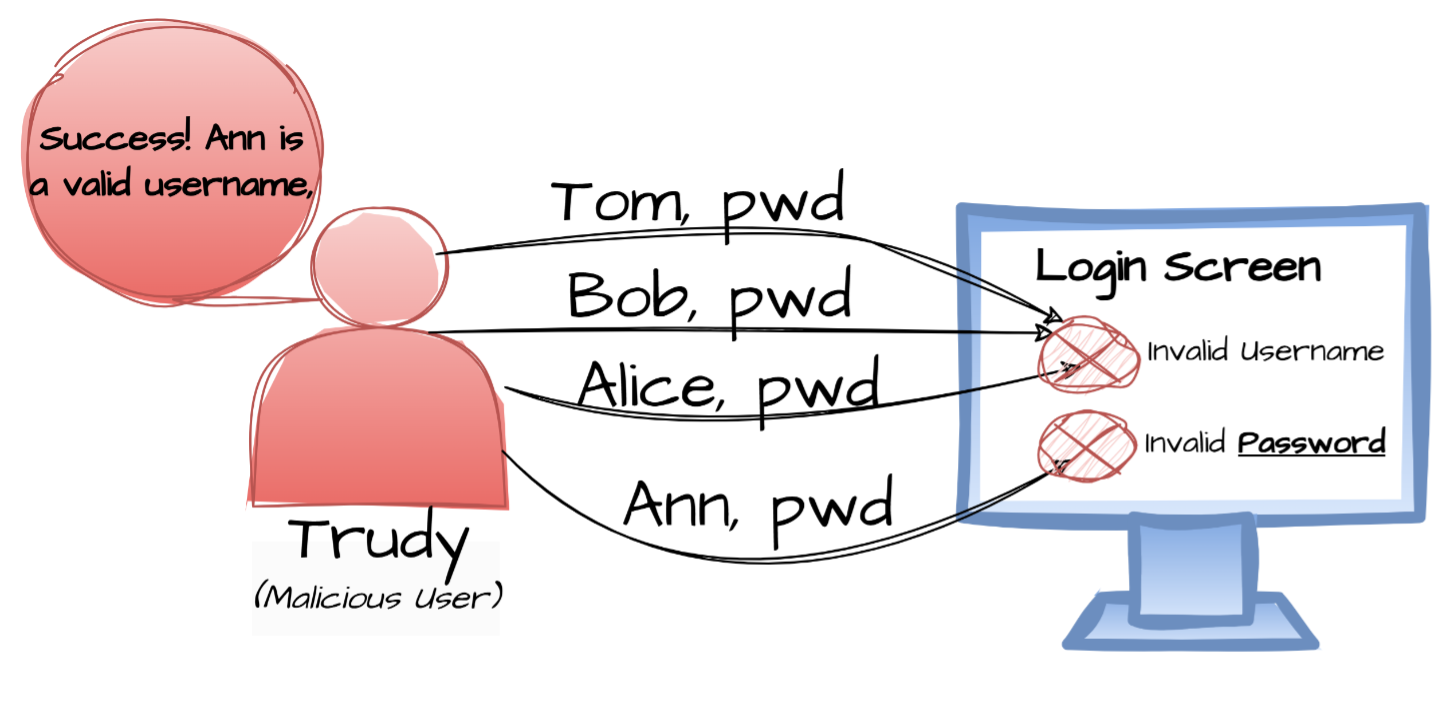
An observable response discrepancy frequently occurs during authentication, where a difference in failed-login messages could allow an attacker to determine if the username is valid or not. The discrepancy could be inadvertent (bug) or intentional (design).

Lifecycle phase

Implementation

An observable response discrepancy frequently occurs during authentication, where a difference in failed-login messages could allow an attacker to determine if the username is valid or not. The discrepancy could be inadvertent (bug) or intentional (design).

Risk

What does successful exploitation lead to?

Read Application DataBypass Protection Mechanism

Affected security scopes: Confidentiality, Access Control

Defence

How is it prevented and fixed?

Architecture and Design

Separation of Privilege

Detail
Compartmentalize the system to have "safe" areas where trust boundaries can be unambiguously drawn. Do not allow sensitive data to go outside of the trust boundary and always be careful when interfacing with a compartment outside of the safe area. Ensure that appropriate compartmentalization is built into the system design, and the compartmentalization allows for and reinforces privilege separation functionality. Architects and designers should rely on the principle of least privilege to decide the appropriate time to use privileges and the time to drop privileges.

Implementation

Implementation-phase defence

Detail
Ensure that error messages only contain minimal details that are useful to the intended audience and no one else. The messages need to strike the balance between being too cryptic (which can confuse users) or being too detailed (which may reveal more than intended). The messages should not reveal the methods that were used to determine the error. Attackers can use detailed information to refine or optimize their original attack, thereby increasing their chances of success. If errors must be captured in some detail, record them in log messages, but consider what could occur if the log messages can be viewed by attackers. Highly sensitive information such as passwords should never be saved to log files. Avoid inconsistent messaging that might accidentally tip off an attacker about internal state, such as whether a user account exists or not.

MITRE diagram

Weakness relationships and flow
CWE-204 MITRE diagramı