COMMON WEAKNESS ENUMERATIONDraft

CWE-209

Generation of Error Message Containing Sensitive Information

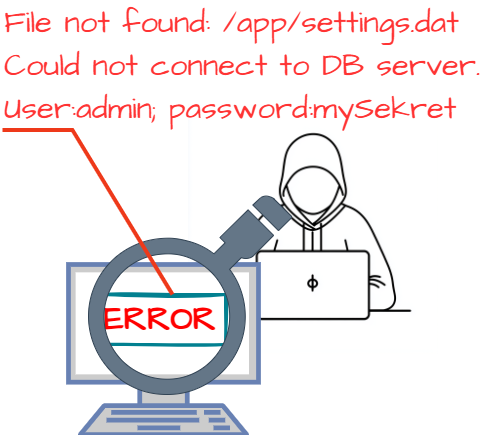
The product generates an error message that includes sensitive information about its environment, users, or associated data.

Abstraction

Base

Structure

Simple

Likelihood of Exploit

High

Understand the problem

What is the problem?

The product generates an error message that includes sensitive information about its environment, users, or associated data.

Root cause

How and when does the problem arise?

Lifecycle phase

Architecture and Design

Lifecycle phase

Implementation

REALIZATION: This weakness is caused during implementation of an architectural security tactic.

Lifecycle phase

System Configuration

Lifecycle phase

Operation

Risk

What does successful exploitation lead to?

Read Application Data

Affected security scopes: Confidentiality

Often this will either reveal sensitive information which may be used to launch another, more focused attack or disclose private information stored in the server. For example, an attempt to exploit a path traversal weakness (CWE-22) might yield the full pathname of the installed application. In turn, this could be used to select the proper number of ".." sequences to navigate to the targeted file. An attack using SQL injection (CWE-89) might not initially succeed, but an error message could reveal the malformed query, which would expose query logic and possibly even passwords or other sensitive information used within the query.

Defence

How is it prevented and fixed?

Implementation

Implementation-phase defence

Detail
Ensure that error messages only contain minimal details that are useful to the intended audience and no one else. The messages need to strike the balance between being too cryptic (which can confuse users) or being too detailed (which may reveal more than intended). The messages should not reveal the methods that were used to determine the error. Attackers can use detailed information to refine or optimize their original attack, thereby increasing their chances of success. If errors must be captured in some detail, record them in log messages, but consider what could occur if the log messages can be viewed by attackers. Highly sensitive information such as passwords should never be saved to log files. Avoid inconsistent messaging that might accidentally tip off an attacker about internal state, such as whether a user account exists or not.

Implementation

Implementation-phase defence

Detail
Handle exceptions internally and do not display errors containing potentially sensitive information to a user.

Implementation

Attack Surface Reduction

Detail
Use naming conventions and strong types to make it easier to spot when sensitive data is being used. When creating structures, objects, or other complex entities, separate the sensitive and non-sensitive data as much as possible.

Effectiveness: Defense in Depth

This makes it easier to spot places in the code where data is being used that is unencrypted.

Implementation · Build and Compilation

Compilation or Build Hardening

Detail
Debugging information should not make its way into a production release.

Implementation · Build and Compilation

Environment Hardening

Detail
Debugging information should not make its way into a production release.

System Configuration

Secure configuration approach

Detail
Where available, configure the environment to use less verbose error messages. For example, in PHP, disable the display_errors setting during configuration, or at runtime using the error_reporting() function.

System Configuration

Secure configuration approach

Detail
Create default error pages or messages that do not leak any information.

Verification

How is it detected?

Manual Analysis

High
This weakness generally requires domain-specific interpretation using manual analysis. However, the number of potential error conditions may be too large to cover completely within limited time constraints.

Automated Analysis

Moderate
Automated methods may be able to detect certain idioms automatically, such as exposed stack traces or pathnames, but violation of business rules or privacy requirements is not typically feasible.

Automated Dynamic Analysis

Moderate
This weakness can be detected using dynamic tools and techniques that interact with the software using large test suites with many diverse inputs, such as fuzz testing (fuzzing), robustness testing, and fault injection. The software's operation may slow down, but it should not become unstable, crash, or generate incorrect results. Error conditions may be triggered with a stress-test by calling the software simultaneously from a large number of threads or processes, and look for evidence of any unexpected behavior.

Manual Dynamic Analysis

Identify error conditions that are not likely to occur during normal usage and trigger them. For example, run the program under low memory conditions, run with insufficient privileges or permissions, interrupt a transaction before it is completed, or disable connectivity to basic network services such as DNS. Monitor the software for any unexpected behavior. If you trigger an unhandled exception or similar error that was discovered and handled by the application's environment, it may still indicate unexpected conditions that were not handled by the application itself.

Automated Static Analysis

Automated static analysis, commonly referred to as Static Application Security Testing (SAST), can find some instances of this weakness by analyzing source code (or binary/compiled code) without having to execute it. Typically, this is done by building a model of data flow and control flow, then searching for potentially-vulnerable patterns that connect "sources" (origins of input) with "sinks" (destinations where the data interacts with external components, a lower layer such as the OS, etc.)

MITRE diagram

Weakness relationships and flow
CWE-209 MITRE diagramı