COMMON WEAKNESS ENUMERATIONIncomplete

CWE-256

Plaintext Storage of a Password

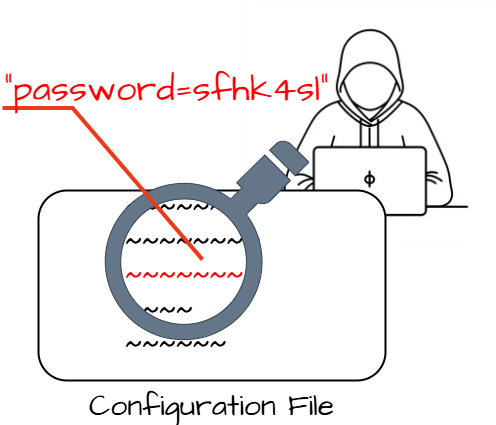
The product stores a password in plaintext within resources such as memory or files.

Abstraction

Base

Structure

Simple

Likelihood of Exploit

High

Understand the problem

What is the problem?

The product stores a password in plaintext within resources such as memory or files.

Root cause

How and when does the problem arise?

Lifecycle phase

Architecture and Design

OMISSION: This weakness is caused by missing a security tactic during the architecture and design phase.

Lifecycle phase

Architecture and Design

Developers sometimes believe that they cannot defend the application from someone who has access to the configuration, but this belief makes an attacker's job easier.

Risk

What does successful exploitation lead to?

Gain Privileges or Assume Identity

Affected security scopes: Access Control

Storing a plaintext password in a configuration file allows anyone who can read the file to access the password-protected resource. In some contexts, even storage of a plaintext password in memory is considered a security risk if the password is not cleared immediately after it is used.

Defence

How is it prevented and fixed?

Architecture and Design

Architecture and design approach

Detail
Avoid storing passwords in easily accessible locations.

Architecture and Design

Architecture and design approach

Detail
Consider storing cryptographic hashes of passwords as an alternative to storing in plaintext.

All phases

General mitigation and defence approach

Detail
A programmer might attempt to remedy the password management problem by obscuring the password with an encoding function, such as base 64 encoding, but this effort does not adequately protect the password because the encoding can be detected and decoded easily.

Effectiveness: None

Verification

How is it detected?

Automated Static Analysis

High
Automated static analysis, commonly referred to as Static Application Security Testing (SAST), can find some instances of this weakness by analyzing source code (or binary/compiled code) without having to execute it. Typically, this is done by building a model of data flow and control flow, then searching for potentially-vulnerable patterns that connect "sources" (origins of input) with "sinks" (destinations where the data interacts with external components, a lower layer such as the OS, etc.)

MITRE diagram

Weakness relationships and flow
CWE-256 MITRE diagramı