COMMON WEAKNESS ENUMERATIONStable

CWE-330

Use of Insufficiently Random Values

The product uses insufficiently random numbers or values in a security context that depends on unpredictable numbers.

Abstraction

Class

Structure

Simple

Likelihood of Exploit

High

Understand the problem

What is the problem?

The product uses insufficiently random numbers or values in a security context that depends on unpredictable numbers.

Root cause

How and when does the problem arise?

Lifecycle phase

Architecture and Design

Lifecycle phase

Implementation

REALIZATION: This weakness is caused during implementation of an architectural security tactic.
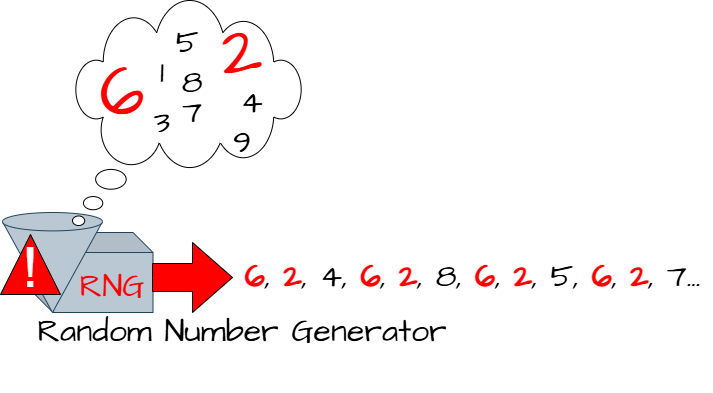
Computers are deterministic machines, and as such are unable to produce true randomness. Pseudo-Random Number Generators (PRNGs) approximate randomness algorithmically, starting with a seed from which subsequent values are calculated. There are two types of PRNGs: statistical and cryptographic. Statistical PRNGs provide useful statistical properties, but their output is highly predictable and forms an easy to reproduce numeric stream that is unsuitable for use in cases where security depends on generated values being unpredictable. Cryptographic PRNGs address this problem by generating output that is more difficult to predict. For a value to be cryptographically secure, it must be impossible or highly improbable for an attacker to distinguish between it and a truly random value.

Risk

What does successful exploitation lead to?

Other

Affected security scopes: Confidentiality, Other

When a protection mechanism relies on random values to restrict access to a sensitive resource, such as a session ID or a seed for generating a cryptographic key, then the resource being protected could be accessed by guessing the ID or key.
Bypass Protection MechanismOther

Affected security scopes: Access Control, Other

If product relies on unique, unguessable IDs to identify a resource, an attacker might be able to guess an ID for a resource that is owned by another user. The attacker could then read the resource, or pre-create a resource with the same ID to prevent the legitimate program from properly sending the resource to the intended user. For example, a product might maintain session information in a file whose name is based on a username. An attacker could pre-create this file for a victim user, then set the permissions so that the application cannot generate the session for the victim, preventing the victim from using the application.
Bypass Protection MechanismGain Privileges or Assume Identity

Affected security scopes: Access Control

When an authorization or authentication mechanism relies on random values to restrict access to restricted functionality, such as a session ID or a seed for generating a cryptographic key, then an attacker may access the restricted functionality by guessing the ID or key.

Defence

How is it prevented and fixed?

Architecture and Design

Architecture and design approach

Detail
Use a well-vetted algorithm that is currently considered to be strong by experts in the field, and select well-tested implementations with adequate length seeds. In general, if a pseudo-random number generator is not advertised as being cryptographically secure, then it is probably a statistical PRNG and should not be used in security-sensitive contexts. Pseudo-random number generators can produce predictable numbers if the generator is known and the seed can be guessed. A 256-bit seed is a good starting point for producing a "random enough" number.

Implementation

Implementation-phase defence

Detail
Consider a PRNG that re-seeds itself as needed from high quality pseudo-random output sources, such as hardware devices.

Architecture and Design · Requirements

Libraries or Frameworks

Detail
Use products or modules that conform to FIPS 140-2 [REF-267] to avoid obvious entropy problems. Consult FIPS 140-2 Annex C ("Approved Random Number Generators").

Verification

How is it detected?

Black Box

Use monitoring tools that examine the software's process as it interacts with the operating system and the network. This technique is useful in cases when source code is unavailable, if the software was not developed by you, or if you want to verify that the build phase did not introduce any new weaknesses. Examples include debuggers that directly attach to the running process; system-call tracing utilities such as truss (Solaris) and strace (Linux); system activity monitors such as FileMon, RegMon, Process Monitor, and other Sysinternals utilities (Windows); and sniffers and protocol analyzers that monitor network traffic. Attach the monitor to the process and look for library functions that indicate when randomness is being used. Run the process multiple times to see if the seed changes. Look for accesses of devices or equivalent resources that are commonly used for strong (or weak) randomness, such as /dev/urandom on Linux. Look for library or system calls that access predictable information such as process IDs and system time.

Automated Static Analysis - Binary or Bytecode

SOAR Partial
According to SOAR [REF-1479], the following detection techniques may be useful: ``` Cost effective for partial coverage: ``` Bytecode Weakness Analysis - including disassembler + source code weakness analysis Binary Weakness Analysis - including disassembler + source code weakness analysis

Manual Static Analysis - Binary or Bytecode

SOAR Partial
According to SOAR [REF-1479], the following detection techniques may be useful: ``` Cost effective for partial coverage: ``` Binary / Bytecode disassembler - then use manual analysis for vulnerabilities & anomalies

Dynamic Analysis with Manual Results Interpretation

SOAR Partial
According to SOAR [REF-1479], the following detection techniques may be useful: ``` Cost effective for partial coverage: ``` Man-in-the-middle attack tool

Manual Static Analysis - Source Code

High
According to SOAR [REF-1479], the following detection techniques may be useful: ``` Highly cost effective: ``` Focused Manual Spotcheck - Focused manual analysis of source Manual Source Code Review (not inspections)

Automated Static Analysis - Source Code

SOAR Partial
According to SOAR [REF-1479], the following detection techniques may be useful: ``` Cost effective for partial coverage: ``` Source code Weakness Analyzer Context-configured Source Code Weakness Analyzer

Architecture or Design Review

High
According to SOAR [REF-1479], the following detection techniques may be useful: ``` Highly cost effective: ``` Inspection (IEEE 1028 standard) (can apply to requirements, design, source code, etc.)

MITRE diagram

Weakness relationships and flow

CWE-330 MITRE diagramı