COMMON WEAKNESS ENUMERATIONDraft

CWE-415

Double Free

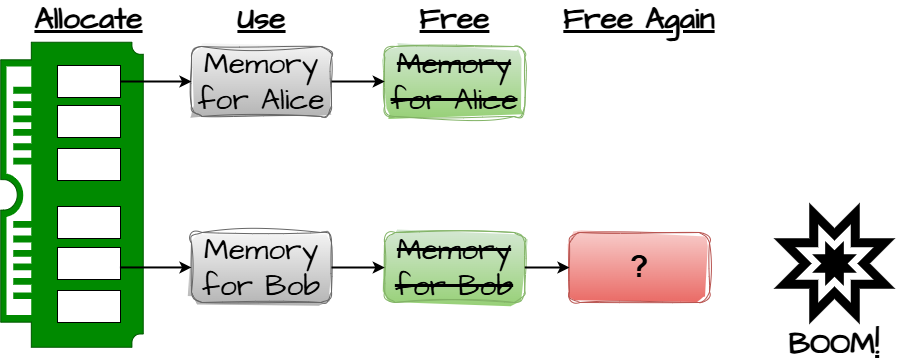
The product calls free() twice on the same memory address.

Abstraction

Variant

Structure

Simple

Likelihood of Exploit

High

Understand the problem

What is the problem?

The product calls free() twice on the same memory address.

Terminology

Alternate terms and usages

Double-free

Root cause

How and when does the problem arise?

Lifecycle phase

Implementation

Risk

What does successful exploitation lead to?

Modify MemoryExecute Unauthorized Code or Commands

Affected security scopes: Integrity, Confidentiality, Availability

When a program calls free() twice with the same argument, the program's memory management data structures may become corrupted, potentially leading to the reading or modification of unexpected memory addresses. This corruption can cause the program to crash or, in some circumstances, cause two later calls to malloc() to return the same pointer. If malloc() returns the same value twice and the program later gives the attacker control over the data that is written into this doubly-allocated memory, the program becomes vulnerable to a buffer overflow attack. Doubly freeing memory may result in a write-what-where condition, allowing an attacker to execute arbitrary code.

Defence

How is it prevented and fixed?

Architecture and Design

Architecture and design approach

Detail
Choose a language that provides automatic memory management.

Implementation

Implementation-phase defence

Detail
Ensure that each allocation is freed only once. After freeing a chunk, set the pointer to NULL to ensure the pointer cannot be freed again. In complicated error conditions, be sure that clean-up routines respect the state of allocation properly. If the language is object oriented, ensure that object destructors delete each chunk of memory only once.

Implementation

Implementation-phase defence

Detail
Use a static analysis tool to find double free instances.

Verification

How is it detected?

Fuzzing

High
Fuzz testing (fuzzing) is a powerful technique for generating large numbers of diverse inputs - either randomly or algorithmically - and dynamically invoking the code with those inputs. Even with random inputs, it is often capable of generating unexpected results such as crashes, memory corruption, or resource consumption. Fuzzing effectively produces repeatable test cases that clearly indicate bugs, which helps developers to diagnose the issues.

Automated Static Analysis

High
Automated static analysis, commonly referred to as Static Application Security Testing (SAST), can find some instances of this weakness by analyzing source code (or binary/compiled code) without having to execute it. Typically, this is done by building a model of data flow and control flow, then searching for potentially-vulnerable patterns that connect "sources" (origins of input) with "sinks" (destinations where the data interacts with external components, a lower layer such as the OS, etc.)

Automated Dynamic Analysis

Moderate
Use tools that are integrated during compilation to insert runtime error-checking mechanisms related to memory safety errors, such as AddressSanitizer (ASan) for C/C++ [REF-1518].

Crafted inputs are necessary to reach the code containing the error, such as generated by fuzzers. Also, these tools may reduce performance, and they only report the error condition - not the original mistake that led to the error.

MITRE diagram

Weakness relationships and flow
CWE-415 MITRE diagramı