COMMON WEAKNESS ENUMERATIONDraft
CWE-521
Weak Password Requirements
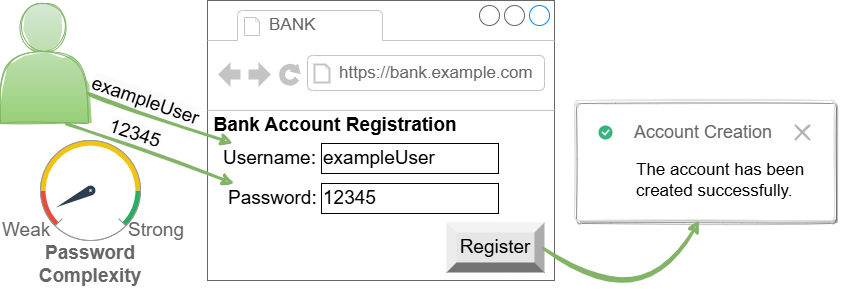
The product does not require that users should have strong passwords.
Abstraction
Base
Structure
Simple
Likelihood of Exploit
Medium
Understand the problem
What is the problem?
The product does not require that users should have strong passwords.
Root cause
How and when does the problem arise?
Lifecycle phase
Architecture and Design
COMMISSION: This weakness refers to an incorrect design related to an architectural security tactic.
Lifecycle phase
Implementation
Not enforcing the password policy stated in a products design can allow users to create passwords that do not provide the necessary level of protection.
Authentication mechanisms often rely on a memorized secret (also known as a password) to provide an assertion of identity for a user of a system. It is therefore important that this password be of sufficient complexity and impractical for an adversary to guess. The specific requirements around how complex a password needs to be depends on the type of system being protected. Selecting the correct password requirements and enforcing them through implementation are critical to the overall success of the authentication mechanism.
Risk
What does successful exploitation lead to?
Gain Privileges or Assume Identity
Affected security scopes: Access Control
An attacker could easily guess user passwords and gain access user accounts.
Defence
How is it prevented and fixed?
Architecture and Design
Architecture and design approach
Detail
Architecture and Design
Architecture and design approach
A product's design should require adherance to an appropriate password policy. Specific password requirements depend strongly on contextual factors, but it is recommended to contain the following attributes:
- Enforcement of a minimum and maximum length
- Restrictions against password reuse
- Restrictions against using common passwords
- Restrictions against using contextual string in the password (e.g., user id, app name)
Depending on the threat model, the password policy may include several additional attributes.
- Complex passwords requiring mixed character sets (alpha, numeric, special, mixed case)
- Increasing the range of characters makes the password harder to crack and may be appropriate for systems relying on single factor authentication.
- Unfortunately, a complex password may be difficult to memorize, encouraging a user to select a short password or to incorrectly manage the password (write it down).
- Another disadvantage of this approach is that it often does not result in a significant increases in overal password complexity due to people's predictable usage of various symbols.
1. Large Minimum Length (encouraging passphrases instead of passwords)
- Increasing the number of characters makes the password harder to crack and may be appropriate for systems relying on single factor authentication.
- A disadvantage of this approach is that selecting a good passphrase is not easy and poor passwords can still be generated. Some prompting may be needed to encourage long un-predictable passwords.
1. Randomly Chosen Secrets
- Generating a password for the user can help make sure that length and complexity requirements are met, and can result in secure passwords being used.
- A disadvantage of this approach is that the resulting password or passpharse may be too difficult to memorize, encouraging them to be written down.
See NIST 800-63B [REF-1053] for further information on password requirements.
Architecture and Design
Architecture and design approach
Detail
Architecture and Design
Architecture and design approach
Consider a second authentication factor beyond the password, which prevents the password from being a single point of failure. See CWE-308 for further information.
Implementation
Implementation-phase defence
Detail
Implementation
Implementation-phase defence
Consider implementing a password complexity meter to inform users when a chosen password meets the required attributes.
Implementation
Implementation-phase defence
Detail
Implementation
Implementation-phase defence
Previously, "password expiration" was widely advocated as a defense-in-depth approach to minimize the risk of weak passwords, and it has become a common practice. Password expiration requires a password to be changed within a fixed time window (such as every 90 days). However, this approach has significant limitations in the current threat landscape, and its utility has been reduced in light of the adoption of related protection mechanisms (such as password complexity and computational effort), along with the recognition that regular password changes often caused users to generate more predictable passwords. As a result, this is now a Discouraged Common Practice [REF-1488] [REF-1489], especially as the sole factor in protecting passwords. It is still strongly encouraged to force password changes in case of evidence of compromise, but this is not the same as a forced "expiration" on an arbitrary time frame.
Effectiveness: Discouraged Common Practice
Verification
How is it detected?
Automated Static Analysis
HighAutomated static analysis, commonly referred to as Static Application Security Testing (SAST), can find some instances of this weakness by analyzing source code (or binary/compiled code) without having to execute it. Typically, this is done by building a model of data flow and control flow, then searching for potentially-vulnerable patterns that connect "sources" (origins of input) with "sinks" (destinations where the data interacts with external components, a lower layer such as the OS, etc.)
MITRE diagram
Weakness relationships and flow