COMMON WEAKNESS ENUMERATIONIncomplete

CWE-565

Reliance on Cookies without Validation and Integrity Checking

The product relies on the existence or values of cookies when performing security-critical operations, but it does not properly ensure that the setting is valid for the associated user.

Abstraction

Base

Structure

Simple

Likelihood of Exploit

Medium

Understand the problem

What is the problem?

The product relies on the existence or values of cookies when performing security-critical operations, but it does not properly ensure that the setting is valid for the associated user.

Root cause

How and when does the problem arise?

Lifecycle phase

Architecture and Design

OMISSION: This weakness is caused by missing a security tactic during the architecture and design phase.

Lifecycle phase

Implementation

Risk

What does successful exploitation lead to?

Modify Application DataExecute Unauthorized Code or Commands

Affected security scopes: Confidentiality, Integrity, Availability

Attackers can easily modify cookies, within the browser or by implementing the client-side code outside of the browser. Reliance on cookies without detailed validation and integrity checking can allow attackers to bypass authentication, conduct injection attacks such as SQL injection and cross-site scripting, or otherwise modify inputs in unexpected ways.
Gain Privileges or Assume Identity

Affected security scopes: Access Control

It is dangerous to use cookies to set a user's privileges. The cookie can be manipulated to escalate an attacker's privileges to an administrative level.

Defence

How is it prevented and fixed?

Architecture and Design

Architecture and design approach

Detail
Avoid using cookie data for a security-related decision.

Implementation

Implementation-phase defence

Detail
Perform thorough input validation (i.e.: server side validation) on the cookie data if you're going to use it for a security related decision.

Architecture and Design

Architecture and design approach

Detail
Add integrity checks to detect tampering.

Architecture and Design

Architecture and design approach

Detail
Protect critical cookies from replay attacks, since cross-site scripting or other attacks may allow attackers to steal a strongly-encrypted cookie that also passes integrity checks. This mitigation applies to cookies that should only be valid during a single transaction or session. By enforcing timeouts, you may limit the scope of an attack. As part of your integrity check, use an unpredictable, server-side value that is not exposed to the client.

Verification

How is it detected?

Automated Static Analysis

High
Automated static analysis, commonly referred to as Static Application Security Testing (SAST), can find some instances of this weakness by analyzing source code (or binary/compiled code) without having to execute it. Typically, this is done by building a model of data flow and control flow, then searching for potentially-vulnerable patterns that connect "sources" (origins of input) with "sinks" (destinations where the data interacts with external components, a lower layer such as the OS, etc.)

MITRE diagram

Weakness relationships and flow
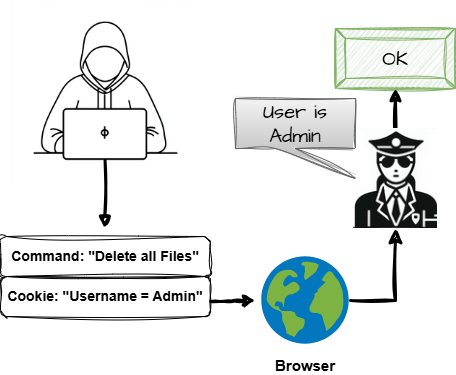
CWE-565 MITRE diagramı
CWE-565: Common Weakness Enumeration Entry CWE-565 · DayBreach Sözlük · DayBreach