COMMON WEAKNESS ENUMERATIONDraft

CWE-601

URL Redirection to Untrusted Site ('Open Redirect')

The web application accepts a user-controlled input that specifies a link to an external site, and uses that link in a redirect.

Abstraction

Base

Structure

Simple

Likelihood of Exploit

Low

Understand the problem

What is the problem?

The web application accepts a user-controlled input that specifies a link to an external site, and uses that link in a redirect.

Terminology

Alternate terms and usages

Open Redirect

Cross-site Redirect

Cross-domain Redirect

Unvalidated Redirect

Drive-by download

an attack, sometimes enabled by open redirects, which redirects the victim to a site that automatically triggers a download action of malicious software or files

Root cause

How and when does the problem arise?

Lifecycle phase

Architecture and Design

OMISSION: This weakness is caused by missing a security tactic during the architecture and design phase.

Lifecycle phase

Implementation

Phishing is a general term for deceptive attempts to coerce private information from users that will be used for identity theft.

Risk

What does successful exploitation lead to?

Bypass Protection MechanismGain Privileges or Assume Identity

Affected security scopes: Access Control

The user may be redirected to an untrusted page that contains malware which may then compromise the user's system. In some cases, an open redirect can also enable the immediate download of a file without the user's permission, because the redirection to an external site may lead to endpoints on those sites that automatically trigger a download action ("drive-by download" [REF-1478]). This will expose the user to extensive risk. The user's interaction with the web server may also be compromised if the malware conducts keylogging or other attacks that steal credentials, personally identifiable information (PII), or other important data.
Bypass Protection MechanismGain Privileges or Assume IdentityOther

Affected security scopes: Access Control, Confidentiality, Other

By modifying the URL value to a malicious site, an attacker may successfully launch a phishing scam. The user may be subjected to phishing attacks by being redirected to an untrusted page. The phishing attack may point to an attacker controlled web page that appears to be a trusted web site. The phishers may then steal the user's credentials and then use these credentials to access the legitimate web site. Because the server name in the modified link is identical to the original site, phishing attempts have a more trustworthy appearance.

Defence

How is it prevented and fixed?

Implementation

Input Validation

Detail
Assume all input is malicious. Use an "accept known good" input validation strategy, i.e., use a list of acceptable inputs that strictly conform to specifications. Reject any input that does not strictly conform to specifications, or transform it into something that does. When performing input validation, consider all potentially relevant properties, including length, type of input, the full range of acceptable values, missing or extra inputs, syntax, consistency across related fields, and conformance to business rules. As an example of business rule logic, "boat" may be syntactically valid because it only contains alphanumeric characters, but it is not valid if the input is only expected to contain colors such as "red" or "blue." Do not rely exclusively on looking for malicious or malformed inputs. This is likely to miss at least one undesirable input, especially if the code's environment changes. This can give attackers enough room to bypass the intended validation. However, denylists can be useful for detecting potential attacks or determining which inputs are so malformed that they should be rejected outright. Use a list of approved URLs or domains to be used for redirection.

Architecture and Design

Architecture and design approach

Detail
Use an intermediate disclaimer page that provides the user with a clear warning that they are leaving the current site. Implement a long timeout before the redirect occurs, or force the user to click on the link. Be careful to avoid XSS problems (CWE-79) when generating the disclaimer page.

Architecture and Design

Enforcement by Conversion

Detail
When the set of acceptable objects, such as filenames or URLs, is limited or known, create a mapping from a set of fixed input values (such as numeric IDs) to the actual filenames or URLs, and reject all other inputs. For example, ID 1 could map to "/login.asp" and ID 2 could map to "http://www.example.com/". Features such as the ESAPI AccessReferenceMap [REF-45] provide this capability.

Architecture and Design

Architecture and design approach

Detail
Ensure that no externally-supplied requests are honored by requiring that all redirect requests include a unique nonce generated by the application [REF-483]. Be sure that the nonce is not predictable (CWE-330).

Note that this can be bypassed using XSS (CWE-79).

Architecture and Design · Implementation

Attack Surface Reduction

Detail
Understand all the potential areas where untrusted inputs can enter your software: parameters or arguments, cookies, anything read from the network, environment variables, reverse DNS lookups, query results, request headers, URL components, e-mail, files, filenames, databases, and any external systems that provide data to the application. Remember that such inputs may be obtained indirectly through API calls. Many open redirect problems occur because the programmer assumed that certain inputs could not be modified, such as cookies and hidden form fields.

Operation

Firewall

Detail
Use an application firewall that can detect attacks against this weakness. It can be beneficial in cases in which the code cannot be fixed (because it is controlled by a third party), as an emergency prevention measure while more comprehensive software assurance measures are applied, or to provide defense in depth [REF-1481].

Effectiveness: Moderate

An application firewall might not cover all possible input vectors. In addition, attack techniques might be available to bypass the protection mechanism, such as using malformed inputs that can still be processed by the component that receives those inputs. Depending on functionality, an application firewall might inadvertently reject or modify legitimate requests. Finally, some manual effort may be required for customization.

Verification

How is it detected?

Manual Static Analysis

High
Since this weakness does not typically appear frequently within a single software package, manual white box techniques may be able to provide sufficient code coverage and reduction of false positives if all potentially-vulnerable operations can be assessed within limited time constraints.

Automated Dynamic Analysis

Automated black box tools that supply URLs to every input may be able to spot Location header modifications, but test case coverage is a factor, and custom redirects may not be detected.

Automated Static Analysis

Automated static analysis tools may not be able to determine whether input influences the beginning of a URL, which is important for reducing false positives.

Automated Static Analysis

High
Automated static analysis, commonly referred to as Static Application Security Testing (SAST), can find some instances of this weakness by analyzing source code (or binary/compiled code) without having to execute it. Typically, this is done by building a model of data flow and control flow, then searching for potentially-vulnerable patterns that connect "sources" (origins of input) with "sinks" (destinations where the data interacts with external components, a lower layer such as the OS, etc.)

Automated Static Analysis - Binary or Bytecode

High
According to SOAR [REF-1479], the following detection techniques may be useful: ``` Highly cost effective: ``` Bytecode Weakness Analysis - including disassembler + source code weakness analysis Binary Weakness Analysis - including disassembler + source code weakness analysis

Dynamic Analysis with Automated Results Interpretation

High
According to SOAR [REF-1479], the following detection techniques may be useful: ``` Highly cost effective: ``` Web Application Scanner Web Services Scanner Database Scanners

Dynamic Analysis with Manual Results Interpretation

High
According to SOAR [REF-1479], the following detection techniques may be useful: ``` Highly cost effective: ``` Fuzz Tester Framework-based Fuzzer

Manual Static Analysis - Source Code

High
According to SOAR [REF-1479], the following detection techniques may be useful: ``` Highly cost effective: ``` Manual Source Code Review (not inspections)

Automated Static Analysis - Source Code

High
According to SOAR [REF-1479], the following detection techniques may be useful: ``` Highly cost effective: ``` Source code Weakness Analyzer Context-configured Source Code Weakness Analyzer

Architecture or Design Review

High
According to SOAR [REF-1479], the following detection techniques may be useful: ``` Highly cost effective: ``` Formal Methods / Correct-By-Construction ``` Cost effective for partial coverage: ``` Inspection (IEEE 1028 standard) (can apply to requirements, design, source code, etc.)

MITRE diagram

Weakness relationships and flow
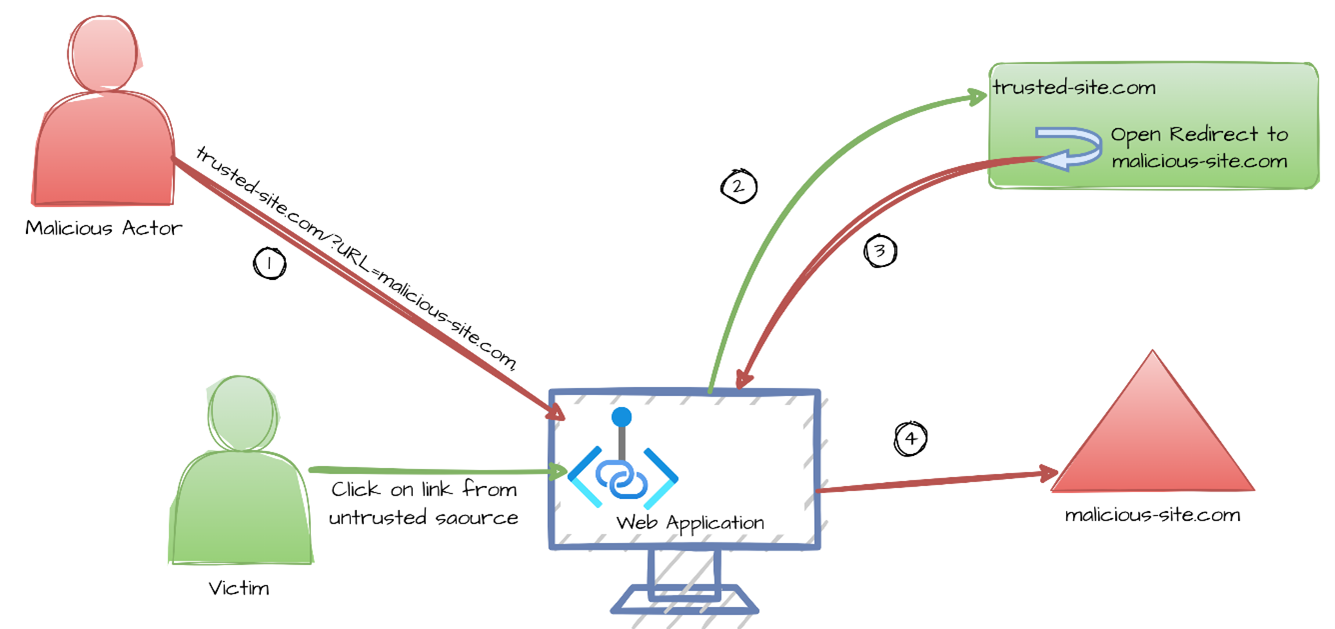
CWE-601 MITRE diagramı