COMMON WEAKNESS ENUMERATIONDraft

CWE-93

Improper Neutralization of CRLF Sequences ('CRLF Injection')

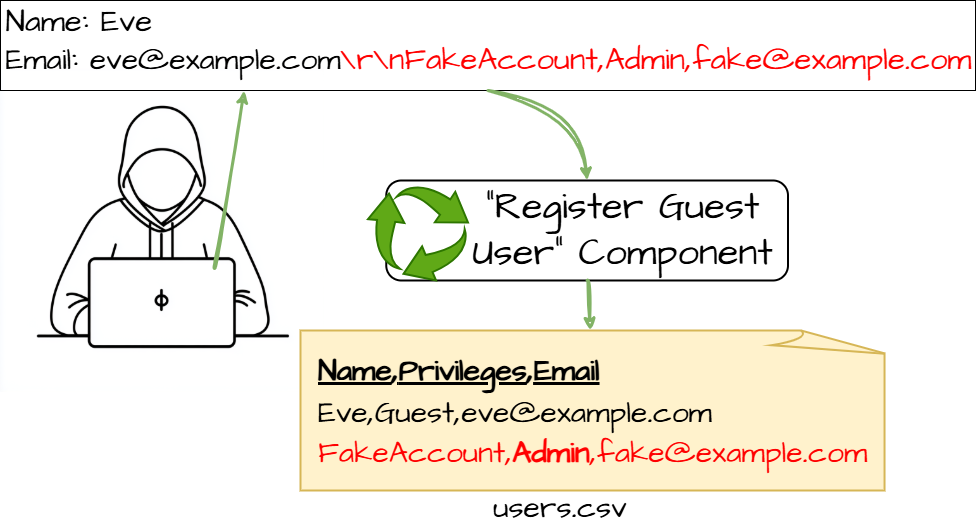
The product uses CRLF (carriage return line feeds) as a special element, e.g. to separate lines or records, but it does not neutralize or incorrectly neutralizes CRLF sequences from inputs.

Abstraction

Base

Structure

Simple

Likelihood of Exploit

Medium

Understand the problem

What is the problem?

The product uses CRLF (carriage return line feeds) as a special element, e.g. to separate lines or records, but it does not neutralize or incorrectly neutralizes CRLF sequences from inputs.

Root cause

How and when does the problem arise?

Lifecycle phase

Implementation

REALIZATION: This weakness is caused during implementation of an architectural security tactic.

Risk

What does successful exploitation lead to?

Modify Application Data

Affected security scopes: Integrity

Defence

How is it prevented and fixed?

Implementation

Implementation-phase defence

Detail
Avoid using CRLF as a special sequence.

Implementation

Implementation-phase defence

Detail
Appropriately filter or quote CRLF sequences in user-controlled input.

Verification

How is it detected?

Automated Static Analysis

High
Automated static analysis, commonly referred to as Static Application Security Testing (SAST), can find some instances of this weakness by analyzing source code (or binary/compiled code) without having to execute it. Typically, this is done by building a model of data flow and control flow, then searching for potentially-vulnerable patterns that connect "sources" (origins of input) with "sinks" (destinations where the data interacts with external components, a lower layer such as the OS, etc.)

MITRE diagram

Weakness relationships and flow
CWE-93 MITRE diagramı