COMMON WEAKNESS ENUMERATIONDraft
CWE-125
Out-of-bounds Read
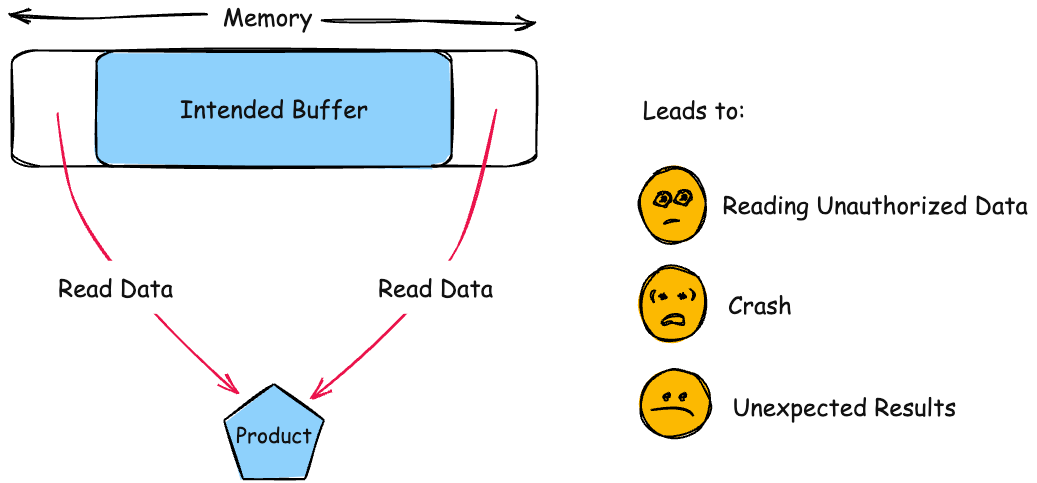
The product reads data past the end, or before the beginning, of the intended buffer.
Soyutlama
Base
Yapı
Simple
Sömürü İhtimali
High
Problemi anla
Problem nedir?
The product reads data past the end, or before the beginning, of the intended buffer.
Terminoloji
Alternatif adlar ve kullanım biçimleri
OOB read
Shorthand for "Out of bounds" read
Kök neden
Problem nasıl ve ne zaman oluşur?
Yaşam döngüsü evresi
Implementation
Risk
Başarılı sömürü neye yol açar?
Read Memory
Etkilenen güvenlik alanları: Confidentiality
An attacker could get secret values such as cryptographic keys, PII, memory addresses, or other information that could be used in additional attacks.
Bypass Protection Mechanism
Etkilenen güvenlik alanları: Confidentiality
Out-of-bounds memory could contain memory addresses or other information that can be used to bypass ASLR and other protection mechanisms in order to improve the reliability of exploiting a separate weakness for code execution.
DoS: Crash, Exit, or Restart
Etkilenen güvenlik alanları: Availability
An attacker could cause a segmentation fault or crash by causing memory to be read outside of the bounds of the buffer. This is especially likely when the code reads a variable amount of data and assumes that a sentinel exists to stop the read operation, such as a NUL in a string.
Varies by Context
Etkilenen güvenlik alanları: Other
The read operation could produce other undefined or unexpected results.
Savunma
Nasıl önlenir ve çözülür?
Implementation
Input Validation
Detay
Implementation
Input Validation
Assume all input is malicious. Use an "accept known good" input validation strategy, i.e., use a list of acceptable inputs that strictly conform to specifications. Reject any input that does not strictly conform to specifications, or transform it into something that does.
When performing input validation, consider all potentially relevant properties, including length, type of input, the full range of acceptable values, missing or extra inputs, syntax, consistency across related fields, and conformance to business rules. As an example of business rule logic, "boat" may be syntactically valid because it only contains alphanumeric characters, but it is not valid if the input is only expected to contain colors such as "red" or "blue."
Do not rely exclusively on looking for malicious or malformed inputs. This is likely to miss at least one undesirable input, especially if the code's environment changes. This can give attackers enough room to bypass the intended validation. However, denylists can be useful for detecting potential attacks or determining which inputs are so malformed that they should be rejected outright.
To reduce the likelihood of introducing an out-of-bounds read, ensure that you validate and ensure correct calculations for any length argument, buffer size calculation, or offset. Be especially careful of relying on a sentinel (i.e. special character such as NUL) in untrusted inputs.
Architecture and Design
Language Selection
Detay
Architecture and Design
Language Selection
Use a language that provides appropriate memory abstractions.
Doğrulama
Nasıl tespit edilir?
Fuzzing
HighFuzz testing (fuzzing) is a powerful technique for generating large numbers of diverse inputs - either randomly or algorithmically - and dynamically invoking the code with those inputs. Even with random inputs, it is often capable of generating unexpected results such as crashes, memory corruption, or resource consumption. Fuzzing effectively produces repeatable test cases that clearly indicate bugs, which helps developers to diagnose the issues.
Automated Static Analysis
HighAutomated static analysis, commonly referred to as Static Application Security Testing (SAST), can find some instances of this weakness by analyzing source code (or binary/compiled code) without having to execute it. Typically, this is done by building a model of data flow and control flow, then searching for potentially-vulnerable patterns that connect "sources" (origins of input) with "sinks" (destinations where the data interacts with external components, a lower layer such as the OS, etc.)
Automated Dynamic Analysis
ModerateUse tools that are integrated during compilation to insert runtime error-checking mechanisms related to memory safety errors, such as AddressSanitizer (ASan) for C/C++ [REF-1518].
Crafted inputs are necessary to reach the code containing the error, such as generated by fuzzers. Also, these tools may reduce performance, and they only report the error condition - not the original mistake that led to the error.
MITRE görseli
Zafiyet ilişkisi ve akışı