COMMON WEAKNESS ENUMERATIONDraft

CWE-126

Buffer Over-read

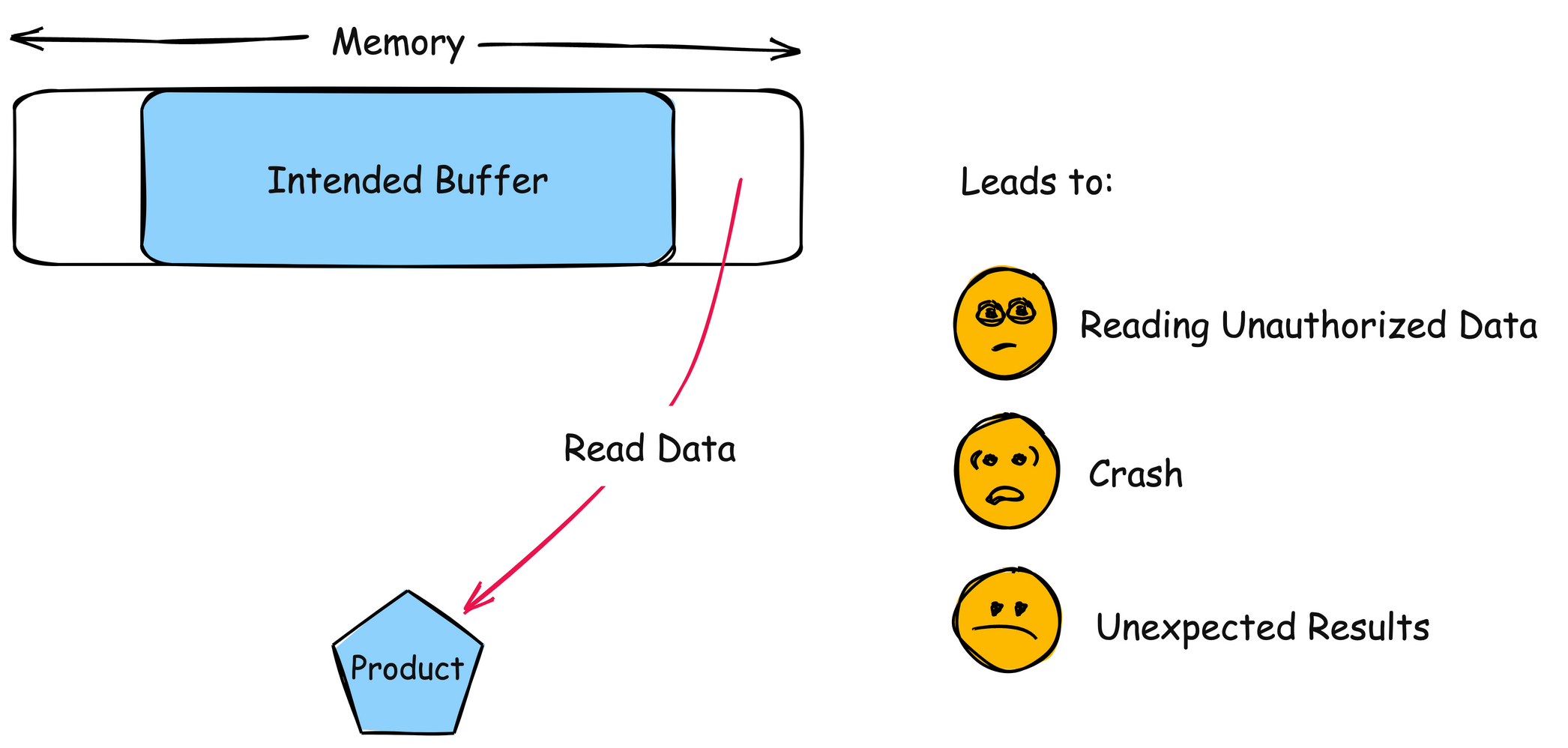
The product reads from a buffer using buffer access mechanisms such as indexes or pointers that reference memory locations after the targeted buffer.

Abstraction

Variant

Structure

Simple

Likelihood of Exploit

Medium

Understand the problem

What is the problem?

The product reads from a buffer using buffer access mechanisms such as indexes or pointers that reference memory locations after the targeted buffer.

Root cause

How and when does the problem arise?

Lifecycle phase

Implementation

Risk

What does successful exploitation lead to?

Read Memory

Affected security scopes: Confidentiality

Bypass Protection Mechanism

Affected security scopes: Confidentiality

By reading out-of-bounds memory, an attacker might be able to get secret values, such as memory addresses, which can bypass protection mechanisms such as ASLR in order to improve the reliability and likelihood of exploiting a separate weakness to achieve code execution instead of just denial of service.
DoS: Crash, Exit, or Restart

Affected security scopes: Availability, Integrity

An attacker might be able to cause a crash or other denial of service by causing the product to read a memory location that is not allowed (such as a segmentation fault), or to cause other conditions in which the read operation returns more data than is expected.

Defence

How is it prevented and fixed?

  • Follow secure coding guidelines for input handling and boundary checking.
  • Enforce strict security reviews and automated static analysis (SAST) checks.

Verification

How is it detected?

Automated Static Analysis

High
Automated static analysis, commonly referred to as Static Application Security Testing (SAST), can find some instances of this weakness by analyzing source code (or binary/compiled code) without having to execute it. Typically, this is done by building a model of data flow and control flow, then searching for potentially-vulnerable patterns that connect "sources" (origins of input) with "sinks" (destinations where the data interacts with external components, a lower layer such as the OS, etc.)

Automated Dynamic Analysis

Moderate
Use tools that are integrated during compilation to insert runtime error-checking mechanisms related to memory safety errors, such as AddressSanitizer (ASan) for C/C++ [REF-1518].

Crafted inputs are necessary to reach the code containing the error, such as generated by fuzzers. Also, these tools may reduce performance, and they only report the error condition - not the original mistake that led to the error.

MITRE diagram

Weakness relationships and flow
CWE-126 MITRE diagramı