COMMON WEAKNESS ENUMERATIONDraft

CWE-611

Improper Restriction of XML External Entity Reference

The product processes an XML document that can contain XML entities with URIs that resolve to documents outside of the intended sphere of control, causing the product to embed incorrect documents into its output.

Abstraction

Base

Structure

Simple

Likelihood of Exploit

Medium

Understand the problem

What is the problem?

The product processes an XML document that can contain XML entities with URIs that resolve to documents outside of the intended sphere of control, causing the product to embed incorrect documents into its output.

Terminology

Alternate terms and usages

XXE

An acronym used for the term "XML eXternal Entities"

Root cause

How and when does the problem arise?

Lifecycle phase

Implementation

REALIZATION: This weakness is caused during implementation of an architectural security tactic.
XML documents optionally contain a Document Type Definition (DTD), which, among other features, enables the definition of XML entities. It is possible to define an entity by providing a substitution string in the form of a URI. The XML parser can access the contents of this URI and embed these contents back into the XML document for further processing.

Risk

What does successful exploitation lead to?

Read Application DataRead Files or Directories

Affected security scopes: Confidentiality

If the attacker is able to include a crafted DTD and a default entity resolver is enabled, the attacker may be able to access arbitrary files on the system. By submitting an XML file that defines an external entity with a file:// URI, an attacker can cause the processing application to read the contents of a local file. For example, a URI such as "file:///c:/winnt/win.ini" designates (in Windows) the file C:\Winnt\win.ini, or file:///etc/passwd designates the password file in Unix-based systems. Once the content of the URI is read, it is fed back into the application that is processing the XML. This application may echo back the data (e.g., in an error message), thereby exposing the file contents.
Bypass Protection Mechanism

Affected security scopes: Integrity

An attacker may supply a crafted DTD using URIs with schemes such as http://, forcing the application to make outgoing HTTP requests to servers that the attacker cannot reach directly, which can be used to bypass firewall restrictions; hide the source of attacks such as port scanning; or otherwise leverage the server's trust relationship with other entities.
DoS: Resource Consumption (CPU)DoS: Resource Consumption (Memory)

Affected security scopes: Availability

The product could consume excessive CPU cycles or memory using a URI that points to a large file, or a device that always returns data such as /dev/random. Alternately, the URI could reference a file that contains many nested or recursive entity references to further slow down parsing.

Defence

How is it prevented and fixed?

Implementation · System Configuration

Defence to apply across several lifecycle phases

Detail
Many XML parsers and validators can be configured to disable external entity expansion.

Verification

How is it detected?

Automated Static Analysis

High
Automated static analysis, commonly referred to as Static Application Security Testing (SAST), can find some instances of this weakness by analyzing source code (or binary/compiled code) without having to execute it. Typically, this is done by building a model of data flow and control flow, then searching for potentially-vulnerable patterns that connect "sources" (origins of input) with "sinks" (destinations where the data interacts with external components, a lower layer such as the OS, etc.)

MITRE diagram

Weakness relationships and flow
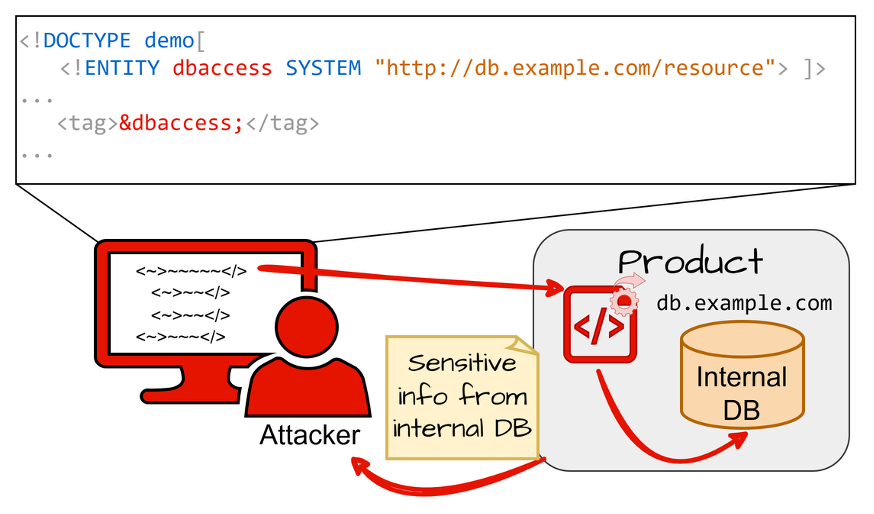
CWE-611 MITRE diagramı
CWE-611: Common Weakness Enumeration Entry CWE-611 · DayBreach Sözlük · DayBreach