COMMON WEAKNESS ENUMERATIONDraft

CWE-598

Use of HTTP Request With Sensitive Query String

The web application uses an HTTP method to process a request, but the request includes sensitive information in the query string.

Abstraction

Variant

Structure

Simple

Likelihood of Exploit

Medium

Understand the problem

What is the problem?

The web application uses an HTTP method to process a request, but the request includes sensitive information in the query string.

Root cause

How and when does the problem arise?

Lifecycle phase

Architecture and Design

Lifecycle phase

Implementation

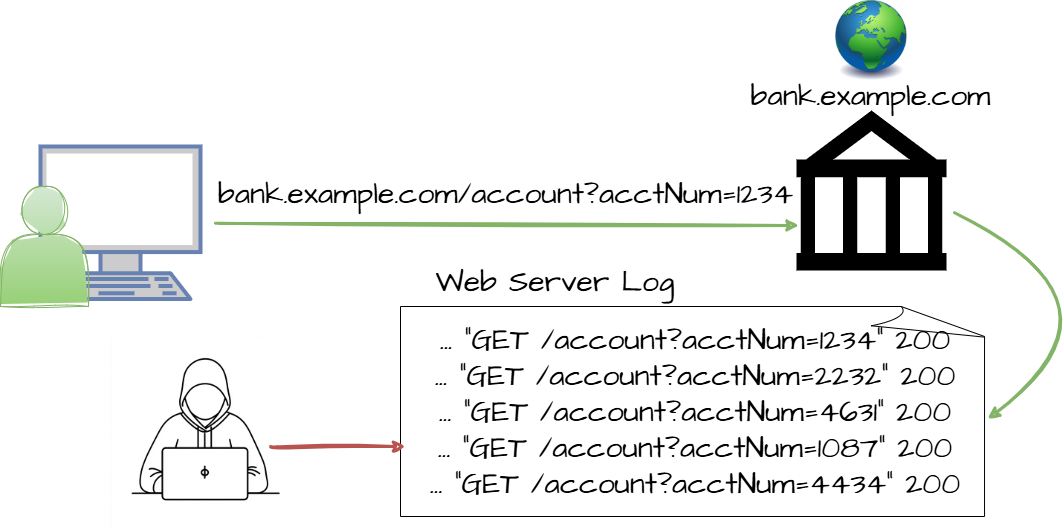
While a query string is frequently used for GET methods, sometimes it is included with other methods such as POST, DELETE, and PUT. The query string for the URL could be saved in the browser's history, passed through Referers to other web sites, stored in web logs, or otherwise recorded in other sources.

Risk

What does successful exploitation lead to?

Read Application Data

Affected security scopes: Confidentiality

At a minimum, attackers can garner information from query strings that can be utilized in escalating their method of attack, such as information about the internal workings of the application or database column names. Successful exploitation of query string parameter vulnerabilities could lead to an attacker impersonating a legitimate user, obtaining proprietary data, or simply executing actions not intended by the application developers. Examples of sensitive information may include secrets such as session identifiers, passwords, access tokens, or API keys; Personally Identifiable Information (PII) such as email addresses or phone numbers; records or logs of private activities; communications that are expected to be private; etc. Successful exploitation of query string parameter vulnerabilities could lead to an attacker impersonating a legitimate user, obtaining proprietary data, or simply executing actions not intended by the application developers.

Defence

How is it prevented and fixed?

Implementation

Implementation-phase defence

Detail
When sending sensitive information, only include it in the request body or request headers instead of the query string. This may require avoiding use of GET requests.

Verification

How is it detected?

Automated Static Analysis

High
Automated static analysis, commonly referred to as Static Application Security Testing (SAST), can find some instances of this weakness by analyzing source code (or binary/compiled code) without having to execute it. Typically, this is done by building a model of data flow and control flow, then searching for potentially-vulnerable patterns that connect "sources" (origins of input) with "sinks" (destinations where the data interacts with external components, a lower layer such as the OS, etc.)

MITRE diagram

Weakness relationships and flow
CWE-598 MITRE diagramı